Is China's parade a plot against the US?
Review
−
03 September 7160 5 minutes
Chinese President Xi Jinping warned on September 3 that the world faces a choice between peace and war, speaking at the country's largest military parade. Standing alongside him were Russian President Vladimir Putin and North Korean leader Kim Jong-un.
The ceremony, marking the 80th anniversary of Japan's defeat in World War II, was largely boycotted by Western nations. Putin and Kim, who remain isolated in the West over the Ukraine conflict and North Korea’s nuclear program, were the main guests at the event. Despite attending the Shanghai Cooperation Organization summit the previous day, several leaders skipped the parade. Indian Prime Minister Narendra Modi, Turkish President Recep Tayyip Erdogan, and Egyptian Prime Minister Mustafa Madbouly left China ahead of the event, sending lower-ranking representatives instead. This highlighted that many nations with ties to the West chose not to attend, wary of China’s overt display of military power.
As noted, most Western countries declined invitations to participate. Their decision reflects rising tensions with Beijing, particularly over China’s support for Russia in the war in Ukraine, its rapidly expanding defense industry, and its confrontational stance in global trade disputes.
The parade, meant to showcase China’s military strength and diplomatic influence, took place amid strained relations with the United States, fueled by President Donald Trump’s trade tariffs and unpredictable policies affecting both allies and rivals.
“Today, humanity faces a choice between peace or war, dialogue or confrontation, victory or defeat. The Chinese people are firmly on the right side of history,” Xi Jinping said, addressing more than 50,000 people in Tiananmen Square.
Xi rode in an open-top convertible to review troops and displays of advanced military hardware, including missiles, tanks, and drones. Overhead, helicopters carrying giant flags and fighter jets flying in formation filled the skies. The 70-minute parade concluded with the release of 80,000 white doves and colorful balloons, symbolizing peace.
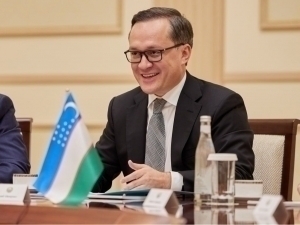
Xi wore a Mao Zedong-style suit and was welcomed on the red carpet by his wife, Peng Liyuan, as well as Uzbek President Shavkat Mirziyoyev and his wife, Ziroatkhan Mirziyoyeva. Uzbek participation in the Beijing ceremony was described as further proof of Uzbekistan’s consistent foreign policy aimed at fostering constructive dialogue at both regional and global levels.
Seated between Putin and Kim Jong-un, Xi continued conversations as troops and equipment passed by the stands.
Meanwhile, U.S. President Donald Trump voiced displeasure over the gathering.
“Please convey my warmest regards to Vladimir Putin and Kim Jong-un, as you are working together against the United States,” Trump wrote on the Truth Social platform as the parade began.
He also emphasized the U.S. role in liberating China from Japan, saying he did not view the parade as a provocation against Washington. A Japanese government spokesperson declined to comment, noting that Japan and China are working to build a “constructive relationship.”
New global order
Xi Jinping has described the victory in World War II as a turning point in the “great rejuvenation of the Chinese nation,” saying it paved the way for the country’s rise as an economic and geopolitical power.
Earlier this week, Xi presented his vision for a new global order at the SCO summit, calling for unity against “hegemonism and power politics.” The remarks were widely seen as a signal to China’s main rival, the United States.
“Xi feels confident. Now the helm is in China’s hands. The main source of instability in the international system has become not China’s ‘bold diplomacy,’ but Trump’s unilateral policies,” said Wen-Ti Sung, a fellow at the Atlantic Council in Taiwan.
Many analysts view recent meetings between Xi, Putin, and Kim Jong-un as a potential catalyst for deeper military cooperation between China, Russia, and North Korea—an alignment that could reshape the security landscape of the Asia-Pacific region.
Putin used the visit to sign new energy deals with Beijing, while Kim Jong-un sought to rally support for his internationally banned nuclear program.
For the first time, Kim attended a major multilateral event and became the first North Korean leader in 66 years to witness a Chinese military parade. His daughter, Zhu E, also traveled to Beijing but was not seen at the event. South Korean intelligence believes she may be groomed as his successor.
Military reform and the Parade’s significance
Over the past two years, Xi has dismissed numerous high-ranking generals from the People’s Liberation Army as part of an anti-corruption campaign.
“The parade gave Xi an opportunity to highlight China’s military advances in modern technology, while simultaneously masking the ongoing purges within the army and tensions among senior commanders,” said John Jin, an analyst at the Brookings Institution.
Experts argue the parade was not only a demonstration of China’s strength to the world but also a tool to bolster national pride and patriotism at home.
In his speech, Xi declared the rejuvenation of the Chinese nation an “unstoppable process.” Civil servants nationwide were instructed to watch the parade and submit their impressions.
Every detail was carefully orchestrated: roads and schools in Beijing were closed, nighttime drills were conducted, and thousands of volunteers and Communist Party members were deployed to maintain order throughout the capital.

Live
AllSamarqandda “gashish” sotayotgan shaxs ushlandi
13 December
“Moyka”da qoldirilgan Malibu o'g'irlab ketildi
13 December