9 square meters of land desertified every minute in Central Asia – Abduhakimov
Local
−
22 November 2025 4877 2 minutes

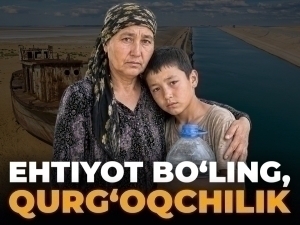
In Central Asian countries, nine square meters of land are desertifying every minute. This was reported on November 22, during a press briefing at the National Committee for Ecology and Climate Change.
“Since the establishment of the Tashkent Observatory in 1868, hydrometeorological research and observations have been conducted. Over the past 170 years, this year is the driest since 1917. This means that our natural factors have intensified significantly,” said Aziz Abduhakimov, head of the committee.
He added that climate change has sharply accelerated desertification. Glaciers in Tajikistan, Kyrgyzstan, and Uzbekistan have decreased by 30–40 percent. Reduced water availability is driving the desertification process.
“Every minute, nine square meters of land in Central Asia are desertifying. In the ten minutes we’ve been talking, 90 square meters of land in the region have degraded or become desertified. We need to explain climate change to people. This is a fact. Regardless of what anyone says, our biggest problem in Uzbekistan and Central Asia is atmospheric issues, and the main concern is desertification,” Abduhakimov said.
According to Daniyor Turgunov, director of the Research Institute of Hydrometeorology, Central Asia lies in a region that produces 70–80 percent of the world’s dust.
“The dust belt stretches from North Africa to Manchuria in China. Uzbekistan itself consists of 80–85 percent desert and semi-desert zones. Some may ask whether this has happened before. Naturally, it has. But the main reason for the current intensification of natural and anthropogenic factors is this year’s drought,” he explained.
It was noted that no rain is expected in Uzbekistan in November, and rainfall is unlikely until December. This has prevented the natural washing of the atmosphere, and, combined with other anthropogenic factors, has maintained high levels of atmospheric turbulence.
“Our region has a sharply continental climate: air temperatures can drop and rise suddenly. As a result, inversion processes occur, affecting vertical air movement. The vertical movement of air remains turbulent, and wind speeds are insufficient to disperse it. This phenomenon is currently observed and represents natural factors that amplify anthropogenic effects,” Turgunov added.
World Bank studies indicate that 36 percent of harmful substances entering the region are caused by natural dust.