Peace efforts, political theatrics and the cost of supporting Israel
Local
−
07 June 7954 17 minutes
The world displayed a striking contrast this week. Russian President Vladimir Putin, whose country has long struggled to boast of major economic opportunities, finally found such an occasion. A major event was held in St. Petersburg.
However, unlike the May 9 celebrations, this event did not pass calmly. Ukrainian drones flew over the city itself. Ukrainian President Volodymyr Zelensky appears determined to resolve the war in a more direct manner. Is the end of the prolonged war near?
The United States and Israel are trying to establish peace in Lebanon. However, Tel Aviv’s commitment to agreements appears to have exhausted Hezbollah’s patience. This time, the group is openly rejecting the proposal. Why does the fire of war in the Middle East continue to burn?
Elections were held for the United Nations Security Council. The results pleased some and alarmed others. While Kyrgyzstan is entering the global stage as a defender of Central Asian interests, Germany, which has openly supported Israel and the genocide in Gaza, failed to secure a seat on the Security Council this time. Does this suggest that negative sentiment toward Israel is also spreading across Europe?
St. Petersburg again in the global spotlight
Russia, and once again Putin, returned to the center of attention. From June 3 to 6 this year, a major international forum was held in St. Petersburg, Russia’s unofficial second capital. This year, the forum, often compared in scale to the World Economic Forum, was attended by nearly 20,000 guests from more than 130 countries.
The St. Petersburg International Economic Forum is a major annual gathering that has been held since 1997. It was initially organized after the collapse of the Soviet Union to attract foreign investment and integrate Russia into the international economic system. Over the past three decades, it has become a platform for Moscow to present its views on the global order and strengthen political ties with foreign partners.
After losing many European markets due to Western sanctions, Russia began redirecting trade and investment toward new partners in Asia, Africa and South America.
Russia managed to hold its Victory Day celebrations without major disruption, but this time the forum was not so calm. On the morning of June 3, Ukrainian drones attacked infrastructure facilities in Russia’s St. Petersburg, including Kronstadt and the Kirov and Krasnoselsky districts. The attack caused a fire at the Petersburg Oil Terminal, one of Russia’s largest liquid cargo transshipment terminals in the Baltic region.
The governor of Leningrad region said 59 drones had been shot down. Restrictions were introduced at Pulkovo Airport on aircraft arrivals and departures. Despite this, the forum continued as planned.
One of the most notable aspects of this year’s forum was the participation of an official U.S. delegation for the first time in eight years. However, the U.S. representatives appeared to have come not to resolve any major economic or political issue, but simply to make an appearance. The U.S. delegation appointed by Donald Trump was headed by Rodney Mims Cook Jr., chairman of the U.S. Commission of Fine Arts, who took part in a session titled “Russia–U.S.: Cultural Dialogue.”
Delegations from China, Brazil, Uzbekistan, Mongolia, Laos, the Philippines, North Korea and many other countries also attended. Saudi Arabia received the status of special guest at the forum in connection with the 100th anniversary of diplomatic relations between the two countries. Leaders of international organizations, including the CIS, OPEC, the Gas Exporting Countries Forum and the BRICS New Development Bank, were also expected to participate.
“We assume that military actions will one day end. Without a doubt, they will end after we achieve the goals we have set for ourselves,” Putin said.
A total of 6.4-6.5 trillion rubles worth of agreements were signed at the forum.
The main documents were signed in the fields of energy, transport, infrastructure, agriculture and petrochemicals. Among the largest were a 2 billion euro investment platform agreement between Russia and Indonesia and the future nuclear power plant project in Uzbekistan.
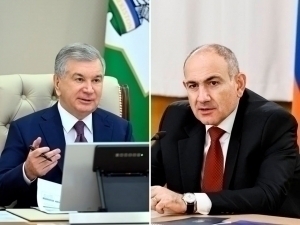
For this reason, the forum was of particular importance for Uzbekistan. During a meeting between Putin and President Shavkat Mirziyoyev, construction of the first power unit of an integrated nuclear power plant in Uzbekistan was launched. The event, held at the Konstantin Palace, marked the third face-to-face meeting between the two leaders in recent times.
The project includes two large-capacity power units based on VVER-1000 reactors and two small units, each with a capacity of 55 MW, based on RITM-200N reactors. According to the Russian side, the project is unique, as small and large-capacity nuclear power plants are being built on the same site for the first time.
“We maintain regular contact with you and always have enough issues to discuss, because the scale of our relations is constantly expanding. This also applies to mutual investments. Russia’s investments in Uzbekistan are growing rapidly and showing positive dynamics. Most importantly, both directions serve the interests of our countries,” the Russian leader said.
Speaking at the plenary session of the St. Petersburg International Economic Forum on June 5, President Shavkat Mirziyoyev emphasized that Russia is a time-tested strategic partner of Uzbekistan.
“For Uzbekistan, Russia is not merely a regional neighbor, but our time-tested strategic partner and ally,” the President said.
At present, none of the five Central Asian states has a nuclear power plant. From this point of view, Uzbekistan is seeking to become a regional leader in developing nuclear energy.
It should not be forgotten that the forum was held amid the ongoing war in Ukraine. Since the war began in 2022, Western governments and many multinational companies have distanced themselves from Russia.
A letter as a weapon
The open letter Zelensky sent to Putin on June 4 was not an ordinary diplomatic appeal. It was a carefully calculated political move. The timing, language and target were not accidental.
The letter was published one day after Ukrainian drones attacked St. Petersburg. At that very time, Putin was hosting world leaders at an economic forum in the same city. In other words, first send drones as a signal, then send a letter with a proposal. This was one of the most delicate forms of wartime diplomacy.
In the letter, Zelensky proposed a ceasefire along the entire front line and a face-to-face meeting between the two presidents in neutral territory, such as Switzerland, Türkiye or an Arab country. He also suggested assigning the monitoring role to the United States. In addition, he proposed an “all-for-all” prisoner exchange and the return of all civilians and children who had been taken away.
In the letter, Zelensky forced Putin to look into a mirror: “You are the first Russian ruler who has been forced to ask the Democratic People’s Republic of Korea for help. Russia is becoming fully dependent on China.”
The letter ended with a warning. Zelensky wrote that if the war continued, Putin would be forced to fight “for his personal existence,” alluding to periods in Russian history when exhaustion from long wars led to political change.
At the time the letter was published, Putin was attending another event. Kremlin spokesman Dmitry Peskov told journalists that he had read the letter but had not yet shown it to Putin. Then came the Kremlin’s official response: “Zelensky can come to Moscow at any time.” That single sentence carried many meanings. On the one hand, it appeared not to reject the proposal. On the other, it suggested holding the meeting in Moscow, under conditions Zelensky had already ruled out. Zelensky had anticipated this in his letter: “The Ukrainian leader has no business in your capital, just as the Russian leader has no business in Kyiv.”
Putin later responded during the plenary session. He described the letter as containing “rather crude expressions” and questioned its purpose: “Was this intended to create conditions for a face-to-face meeting, or, on the contrary, to prevent such a meeting? I think it was the latter.”
In his speech at the forum, Putin once again made his goal clear: “Military actions will certainly end one day. But this will happen after we achieve the goals we have set for ourselves.”
According to Kyiv Independent sources, Zelensky’s letter was intended not only for Putin, but for a much broader audience. According to a senior official close to the Ukrainian president, the main target of the letter was Putin’s inner circle, the Russian elite increasingly tired of the war, and even ordinary Russian citizens.
Ukrainian officials say the proposal itself was only half the objective. The second aim was to once again show the public that Kyiv had offered negotiations, while the rejection came from Moscow, thereby creating a historical record.
This is a very subtle layer of diplomacy. Zelensky wrote the letter knowing he would receive a “no,” but the goal was not a “yes.” The goal was precisely that “no,” because it once again demonstrated to the world that Russia itself wants to continue the war.
Zelensky also wrote about this: “We all see that Russians are gradually becoming dissatisfied with this reality. The war is bringing increasingly negative consequences for Russia.”
The response came as expected. Zelensky assessed the Kremlin’s position by saying: “The Russian side is again choosing the path of war. This is a weak response. I think many people around the world will be disappointed by this answer.”
Zelensky and Putin have met face-to-face only once, in Paris in December 2019. Since then, the two leaders have not held direct talks.
Seven years have passed since then. Four years have passed since the start of the war. Istanbul, Abu Dhabi and Geneva have all hosted talks, but none produced any result on the territorial issue. U.S. attention has shifted to the Iranian front. Trump responded to Zelensky’s proposal by saying that it would be good if the two leaders met, but that both sides would have to make concessions. In other words, he again offered a noncommittal opinion.
This week’s events showed the following: a letter was sent, drones flew, a forum was held, a response came, but the war continues. As the number of agreements signed in St. Petersburg grows, so does the smoke over Kyiv and Kharkiv.
The theater of peace efforts
The Israel-Lebanon ceasefire agreement, signed in November 2024 with U.S. and French mediation, was due to expire on March 2, 2026. However, before that, on February 28, 2026, the day after Israel and the United States struck Iran, Hezbollah resumed attacks, dragging Lebanon back into war.
With the start of a new full-scale armed conflict, tensions between the sides turned into an extremely complex diplomatic maze. Lebanon has become a battlefield for several players at once: the government, Israel, Hezbollah, the United States and Iran.
On June 1 this year, U.S. Secretary of State Marco Rubio advanced a new initiative aimed at easing the conflict between Israel and Lebanon. Over the previous 48 hours, he had held talks with Lebanese President Joseph Aoun and Israeli Prime Minister Benjamin Netanyahu.
Under the U.S. proposal, in the first stage, Hezbollah was to stop all attacks against Israel. In response, Israel was to commit to not intensifying military actions against Beirut.
Lebanese President Joseph Aoun supports the U.S. ceasefire proposal. Lebanese Parliament Speaker Nabih Berri said Hezbollah would observe a ceasefire regime, but placed responsibility for the initial steps of the truce on Israel. A U.S. administration official said Hezbollah was following Iran’s policy and was interested in prolonging the conflict. According to the official, Iran is trying to extend the situation in Lebanon in order to later demonstrate its role in resolving the conflict.
Israel and Lebanon reached a new ceasefire agreement on the condition that Hezbollah halt its attacks. The U.S. State Department officially announced the agreement.
Under the deal, the Lebanese Armed Forces were to gain full control of the territory from the Litani River to the Israeli border, while Hezbollah fighters were to leave these areas.
The United States undertook to assist in establishing security zones in these areas without non-state armed groups.
However, the announcement of the agreement changed nothing, and the bloodshed did not stop. On June 3, Israeli strikes on southern Lebanon killed at least nine people. Hezbollah, meanwhile, continued carrying out rocket attacks on northern Israel.
The new agreement was reached after repeated violations of a ceasefire achieved in April. This shows that diplomatic documents are increasingly remaining nothing more than “a piece of paper.”
One of the key players, Hezbollah, refused on June 3 to accept the new U.S.-mediated ceasefire agreement between Israel and Lebanon. The group had its reasons. Hezbollah leader Naim Qassem said the demand to withdraw fighters from southern Lebanon as a concession to the opposing side was equivalent to “surrender and defeat.” He called the talks “meaningless, humiliating and insulting.”
“We demand only a complete end to aggression, a ceasefire and Israel’s withdrawal. Until our villages are safe, northern Israel will not be safe either,” Qassem said.
Iran is also presenting the resolution of the conflict in Lebanon as a key condition of any agreement with the United States. Esmail Qaani, commander of the Quds Force of Iran’s Islamic Revolutionary Guard Corps, is demanding not only a ceasefire but also the withdrawal of Israeli troops to their pre-war positions.
Despite this, Lebanese Prime Minister Nawaf Salam announced that the Lebanese army would begin deploying in “pilot security zones” where neither Hezbollah nor Israel would be present.
Although ceasefire regimes have been announced several times, fighting continues. Since the start of the fighting in Lebanon, more than 3,500 people have been killed and more than 1.2 million have been forced to leave their homes. Israel says it has lost 27 soldiers and three civilians.
The sides are scheduled to hold further talks on June 22 to discuss the possibility of reaching a comprehensive peace agreement. However, Hezbollah’s firm rejection and the real situation on the ground raise doubts about how effective these negotiations can be.
What is the temporary composition of the UN Security Council?
The UN Security Council consists of 15 members. Five of them — the United States, the United Kingdom, France, Russia and China — are permanent members with veto power, meaning they can block any draft resolution. The remaining 10 seats belong to non-permanent members, who are elected for two-year terms. Although they do not have veto power, non-permanent members play an important role in shaping negotiations and ensuring that issues concerning their regions are taken into account. Non-permanent members are elected by secret ballot in the UN General Assembly and must receive a two-thirds majority of votes from member states.
The UN General Assembly elected Austria, Zimbabwe, Portugal, Trinidad and Tobago, and, for the first time in history, Kyrgyzstan as non-permanent members of the Security Council for the 2027-2028 term.
Kyrgyzstan competed fiercely with the Philippines for the Asia-Pacific Group seat over four rounds of secret voting and won with 142 votes, defeating the Philippines, which received 49 votes.
For the first time since gaining independence in 1991, Kyrgyzstan was elected as a non-permanent member of the UN Security Council. Its new term will begin on January 1, 2027, and continue until December 31, 2028.
This marks Central Asia’s return to the Council after more than a decade. The last time a country from the region held a seat was Kazakhstan in 2017-2018.
For Kyrgyzstan, this is not merely a diplomatic achievement, but the result of decades of effort. President Sadyr Japarov had called on world leaders to support Kyrgyzstan and emphasized the need to expand the representation of countries that had never served on the Council. Foreign Minister Jeenbek Kulubaev, meanwhile, called for reforms at the UN to increase the number of permanent members from Asia, Africa and Latin America.
Kyrgyzstan’s victory is also seen as linked to its increased diplomatic activity in recent months following the appointment of Edil Baisalov as ambassador to the United States. In May, Baisalov led intensive lobbying efforts in Washington.
Compared with its neighbors, Kyrgyzstan has often remained “invisible” in international institutions. Its victory over a country with strong diplomatic traditions such as the Philippines indicates that the region’s role on the international stage is growing.
Germany and the Jews
On the same election day, another historic result occurred. This time, however, it was not a victory but a defeat. Germany lost an election for a non-permanent seat on the UN Security Council for the first time. Competing for two seats from the Western European and Others Group, Germany fell behind Austria and Portugal.
Although German Foreign Minister Johann Wadephul lobbied around 80 ministers and ambassadors in New York, Germany received only 104 votes. Austria received 131 votes and Portugal received 134, surpassing Germany.
Since German reunification in 1990, the country had become a non-permanent member of the Security Council every eight years without major obstacles. The breaking of this tradition for the first time caused significant political resonance in Berlin.
German Foreign Minister Wadephul openly acknowledged two reasons for the defeat. One was Germany’s position on Russia’s war in Ukraine, while the second and more sensitive reason was said to be linked to its support for Israel.
Trita Parsi, executive vice president of the Quincy Institute for Responsible Statecraft, rejected the argument that Germany’s support for Ukraine was the cause.
“Let’s be realistic. Germany’s support for Ukraine has nothing to do with this. Austria and Portugal, the countries that defeated Germany, support Ukraine no less than Germany does,” Parsi said.
Craig Mokhiber, former director of the New York office of the UN High Commissioner for Human Rights, supported the same view. According to him, Germany’s support for the Israeli government on the Palestine issue and its blind backing of the genocide in Gaza cost Berlin dearly.
Despite the International Criminal Court issuing an arrest warrant for Israeli Prime Minister Netanyahu in 2024 and the International Court of Justice ordering Israel to refrain from acts of genocide, German Chancellor Friedrich Merz visited Israel and met Netanyahu. During Merz’s visit to Israel, Germany lifted a three-month suspension on arms exports that could be used in Gaza. Later investigations showed that arms exports from Germany to Israel had continued even during the restriction period.
Austria is also traditionally considered one of Israel’s strongest supporters in Europe. However, as a smaller and militarily neutral state, it remained outside the criticism directed at Berlin.
The UN election result showed that even in the global West, Israel’s current crimes are not being received positively. Germany’s diplomatic setback is being interpreted as the price of such one-sided policy.
Kyrgyzstan’s victory is a new voice. Germany’s defeat is a crack in the old system. Both happened on the same day, in the same hall.

Live
All