Mirziyoyev criticizes the fragmented global situation
Local
−
07 October 5893 11 minutes
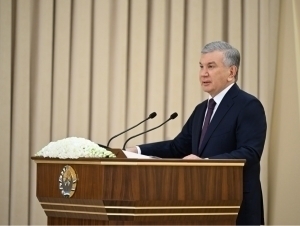
The regular meeting of the Council of Heads of State of the Organization of Turkic States (OTS) was held today, October 7, in the city of Gabala, Azerbaijan. The event, chaired by President of Azerbaijan Ilham Aliyev, was attended by President of Uzbekistan Shavkat Mirziyoyev, who put forward a number of initiatives.
“Distinguished heads of delegations,
I am very pleased to meet you, my dear brothers, in the unique city of Gabala, which has been one of the key centers of trade and culture along the Great Silk Road since ancient times.
First of all, I express my sincere gratitude to the President of the Republic of Azerbaijan, His Excellency Ilham Heydarovich Aliyev, for organizing this summit at a high level and for the traditional and warm hospitality.
Thanks to your direct initiative, we have visited many regions of modern Azerbaijan in recent years. We have witnessed the rapid development of the beautiful Karabakh region and large-scale construction projects in the cities of Shusha, Khankendi, and Aghdam. As your close friends, we are deeply pleased by these positive developments.
It would not be an exaggeration to say that the Peace Declaration signed with Armenia, made possible by your strong political will, is a shared victory for the Turkic states. This historic agreement opens up broad opportunities for closer cooperation among our countries in trade, economy, transport, and humanitarian spheres.
Dear colleagues,
I would like to express my gratitude to His Excellency Sadyr Nurgozhoevich Japarov, President of the Kyrgyz Republic, for his effective chairmanship of our Organization throughout the year and for his significant contribution to elevating our cooperation to a new level.
Our meeting today, held under the theme “Regional Peace and Security,” is taking place amid complex geopolitical changes and growing threats to global security. My colleagues who spoke before me have shared their views and proposals on these challenges.
The speeches and approaches of world leaders at the recent anniversary session of the United Nations General Assembly in New York once again demonstrated the lack of a unified position on the political and security architecture of the modern world.
The times demand that we deeply reform and improve the system of global governance and strengthen the role of the UN and its Security Council. In particular, strengthening the position and voice of developing countries through closer cooperation is an important task.
The most pressing global issues, the escalating and seemingly unending conflicts and wars in the Eurasian region, are undoubtedly having negative effects on our countries as well.
The tragedy in the Gaza Strip, the situation around Ukraine, the issue of Iran’s nuclear program, and the question of Afghanistan’s stability are all causes of serious concern for us.
We welcome the efforts and new plans of the world's major powers to shape a just world order and build mutual trust and security.
I believe that in order to deeply analyze the global situation and make the necessary decisions, it is necessary to hold regular joint meetings of the foreign ministers and heads of security services of the Organization of Turkic States. We propose holding the first such joint meeting next year in the city of Samarkand.
Distinguished heads of delegations,
Analysis shows that the Organization of Turkic States has quickly become one of the rapidly developing and influential international organizations. Above all, the activation of high-level political dialogue, the strengthening of mutual trust, and the implementation of practical partnership projects and humanitarian programs clearly confirm this.
Let me give you one example. Today, more than thirty-five areas of practical cooperation are being implemented within our Organization. Mutual trade volume among our countries is steadily growing, and it is expected to double by 2030.
Based on today’s agenda, I would like to focus on several key issues.
One of our top priorities is to further enhance the status and capacity of our Organization and to strengthen its role as a platform for effective cooperation in the near future.
In this regard, we support the speedy negotiation and adoption of the Treaty on Strategic Partnership, Eternal Friendship, and Brotherhood among Turkic states. This important agreement will serve as a key political document in deepening our cooperation, bringing our brotherly nations even closer together, and taking practical ties to a new stage.
To further expand and accelerate our multifaceted partnership, we propose developing a Development Strategy and a separate “roadmap” for the Organization until 2030. In this regard, we consider it appropriate to focus on the following specific areas and measures.
First, we see the development of trade and economic relations and the deepening of industrial cooperation among our countries as a key priority.
In the near future, we support the formation of a new space of economic opportunities within our Organization. This primarily involves creating the most favorable conditions, legal frameworks, and infrastructure for trade, business, and mutual investment.
To consistently develop practical cooperation and design specific projects — including agreeing on plans within the framework of the Turkic Investment Fund — it is time to establish a permanent Council on Economic Partnership of the Turkic States. This structure, managed by the deputy prime ministers of our countries, should operate on a permanent basis. We are ready to host the Council’s Project Office in Tashkent.
Within the Council, we can implement several new initiatives. In particular, we should establish the Turkic Industrial Alliance to advance cooperation projects among our leading companies in mechanical engineering, mining, electrical engineering, petrochemicals, pharmaceuticals, light industry, food production, and construction materials. We must introduce an electronic system of “Turkic Green Corridors” to sharply increase mutual trade volumes and harmonize technical regulations. It is also necessary to jointly implement projects in “green energy,” “green hydrogen and ammonia,” attract advanced technologies, standards, and competencies, and widely apply public-private partnership mechanisms by creating a “Green Transformation” consortium. Furthermore, the Council should pay special attention to developing a strategic mineral base and producing value-added products.
It is crucial to adopt a practical Cooperation Program based on the principle of “raw materials – processing – science and technology – finished products.”
Second, our countries can become world leaders in producing and supplying organic agricultural products, which are key to ensuring food security.
According to FAO analysis, the volume of the global organic products market today exceeds $225 billion, and this figure is expected to grow by 10 percent annually in the coming years.
Given the potential of our countries in this area, we must strengthen scientific research and selection, industrial cooperation, and logistics networks to produce high-quality and in-demand organic products.
In the future, our organic products could enter the global market under a single brand. In this regard, we propose creating an Expert Working Group under the supervision of our ministers of agriculture to select and implement initial “pilot” projects in our countries.
Third, we all deeply understand the need to strengthen transport connectivity among Turkic states and pursue a coordinated policy in developing international transit corridors.
We fully support all the plans mentioned for the consistent development of the Middle Corridor. Most importantly, this corridor must be competitive and provide the most favorable conditions for the business community.
We attach great importance to projects aimed at applying optimal transit tariffs, developing modern transport infrastructure, and introducing digitalized customs procedures.
It is worth noting that if the Middle Corridor is connected with the China–Kyrgyzstan–Uzbekistan railway currently under construction and the promising Trans-Afghan route, we will create a multi-branch strategic transport network across our vast region.
I am confident that all our transport-related initiatives will be discussed in detail at the International Forum on Multimodal Transportation, which will be held on November 12 in Tashkent. We hope for the active participation of national delegations composed of transport ministers, heads of major logistics companies and associations, as well as scientists and experts.
Fourth, when we speak about large industrial and infrastructure projects, the introduction of effective financial instruments is of particular importance.
In this regard, we are in favor of expanding the activities of the Turkic Investment Fund. At the same time, to attract additional funds for priority projects, we propose adopting a Strategic Partnership Program with the Islamic Development Bank, the European Bank for Reconstruction and Development, other international financial institutions, and national development institutions.
Fifth, artificial intelligence, digitalization, and the creative economy are becoming key drivers of sustainable development in our countries.
To unite our efforts in these areas, we propose adopting a “roadmap” for the implementation of Artificial Intelligence and Creative Economy projects.
We also propose hosting the International Exhibition of the Turkic World in our country.
Sixth, it is important to raise our cooperation in science and education to a new level based on the principle of “Enlightenment Against Ignorance.”
Uzbekistan will chair the Union of Turkic Universities, which unites more than 100 universities, in 2025–2026. The Union’s General Assembly will be held in Tashkent next week.
During our chairmanship, we propose organizing the “Days of Turkic Science and Innovation.”
To strengthen cooperation in the field and encourage the research of talented scientists, the International University of the Turkic States is starting its operations in Uzbekistan. Based on this institution, it would be highly beneficial to develop a Joint Research Support Program.
Seventh, in order to prevent the spread of alien and destructive ideas among our youth, I propose adopting an Action Plan to combat extremist and radical ideologies across the Turkic world.
At the same time, we will continue close dialogue in combating all forms of Islamophobia.
In addition, developing joint initiatives within our Organization to improve environmental literacy among young people will undoubtedly be an important step.
I would also like to highlight another matter. Next year, we will widely celebrate the 585th anniversary of the great poet and thinker Alisher Navoi and the 885th anniversary of the prominent Azerbaijani poet Nizami Ganjavi.
To widely promote the ideas of humanism, mutual friendship, and solidarity expressed in the invaluable literary heritage of these classical figures, we propose organizing an international scientific conference titled “The Works of Nizami Ganjavi and Alisher Navoi in the Spiritual Life of the Turkic World.”
Distinguished heads of delegations,
In conclusion, I wish great success to His Excellency Ilham Heydarovich Aliyev, President of the Republic of Azerbaijan, who is assuming the chairmanship of our Organization.
I am confident that the Gabala Declaration, which will be adopted today, will further strengthen our common initiatives and plans and make a worthy contribution to the overall development of our states and the well-being of our brotherly peoples.
Thank you for your attention,” Mirziyoyev said.
For reference, the initiative to organize meetings of Turkic states was put forward by the Republic of Türkiye in 1991–1992, and the first summit in this format was held in Ankara in 1992.
Subsequent summits were held in Istanbul in 1994, Bishkek in 1995, Tashkent in 1996, Astana in 1998, Baku in 2000, Istanbul in 2001, Antalya in 2006, and Nakhchivan in 2009. It was at the Nakhchivan summit that the “Nakhchivan Agreement on the Establishment of the Cooperation Council of Turkic-Speaking States” was signed, transforming meetings in this format into a formal council.
On September 14, 2019, the Republic of Uzbekistan ratified the Nakhchivan Agreement on the Establishment of the Cooperation Council of Turkic-Speaking States and became a full member of the organization.
On November 12, 2021, during the eighth summit of the Council in Istanbul, the “Cooperation Council of Turkic-Speaking States” was renamed the “Organization of Turkic States.”
The member and observer states of the OTS have a combined population of about 150 million and are located in a large and strategically important geopolitical area covering 4.2 million square kilometers. The member states also hold a significant position in the global economy.
The OTS Secretariat is based in Istanbul, Republic of Türkiye.
The main purpose of the OTS is to promote comprehensive cooperation among its members (Azerbaijan, Türkiye, Kazakhstan, Kyrgyzstan, Uzbekistan).
The Organization’s objectives are:
- to strengthen mutual trust, friendship, and good neighborly relations among the parties;
- to ensure peace and security in the region and beyond;
- to adopt common positions on foreign policy issues;
- to promote effective regional and bilateral cooperation in all areas related to common goals;
- to create favorable conditions for trade and investment among member states;
- to discuss issues of rule of law, effective governance, and the protection of human rights;
- to expand cooperation in science, technology, education, and culture;
- to develop cooperation and communication with the media;
- to facilitate the exchange of information on legal matters.
The OTS observers are Hungary (since 2018) and Turkmenistan (since 2021).

Live
All