Tashkent’s urban evolution: Renovation, sustainability, and economic growth
Local
−
14 May 10823 2 minutes
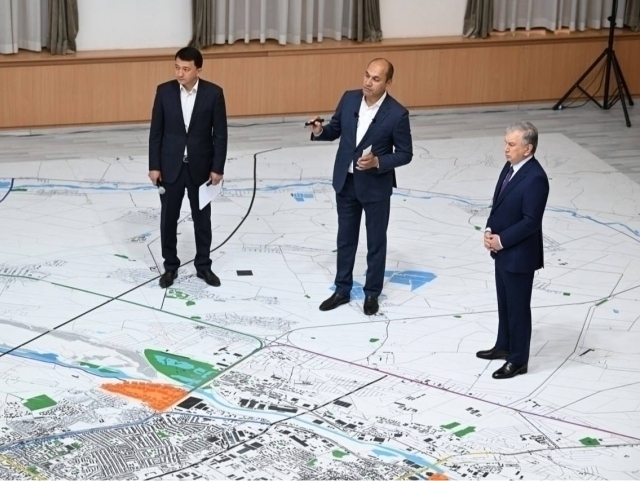
Tashkent’s urban landscape is set for a transformation under the newly approved 2045 Master Plan. On December 24, 2024, the Cabinet of Ministers formally endorsed the blueprint, which divides the capital into three key zones—conservation, reconstruction, and renovation. During a presentation on May 14, President Shavkat Mirziyoyev was briefed on planned renovation and investment projects aimed at reshaping the city. The renovation zone specifically targets outdated, low-rise housing and structurally vulnerable buildings that do not meet urban planning and seismic resilience requirements. These structures will be phased out, making room for modern developments.
The master plan outlines over 300 renovation sites, with 65 projects scheduled for the first phase (2025–2026). These revitalization efforts aim to enhance functionality, improve living conditions, and integrate green spaces, reducing the contrast between old and modern neighborhoods.
Buildings will be constructed in compact areas to preserve existing trees, while new green spaces will be established. The President has emphasized that urban redevelopment must align with architectural and infrastructure needs while undergoing rigorous geological and seismic assessments to ensure safety.
Residential areas should incorporate schools, preschools, and recreational spaces, ensuring a balanced living environment for residents.
A major focus of the master plan is environmental sustainability. Tashkent’s green zones will be tripled, expanding to 25,000 hectares, necessitating improvements in the city’s water channels.
Infrastructure modernization includes irrigation and drainage systems designed to support urban expansion. By 2030, 100 kilometers of city canals will be reconstructed and landscaped into recreational zones.
Collaborating with Turkey’s Su-yapi Engineering and Consulting, experts have analyzed drainage system challenges using aerial photography, geodesy, and precipitation models. A comprehensive renewal master plan was developed, addressing previous flooding hotspots. Last year, 45 flood-prone areas were resolved, with efforts continuing in 34 more locations this year.
President Mirziyoyev received updates on the investment climate in Tashkent, where 717 investment projects totaling $25 billion have been launched. In 2025, $7.5 billion will be allocated, with 265 projects expected to be completed, including residential complexes, commercial centers, and entertainment hubs. Industrial facilities are also planned to drive economic expansion.
With these large-scale developments, Tashkent is poised to become a modern, resilient, and environmentally sustainable city, harmonizing its rich historical heritage with contemporary urbanization efforts.

Live
All