Chamber of Court Administrators to be established in Uzbekistan
Local
−
03 April 3464 5 minutes
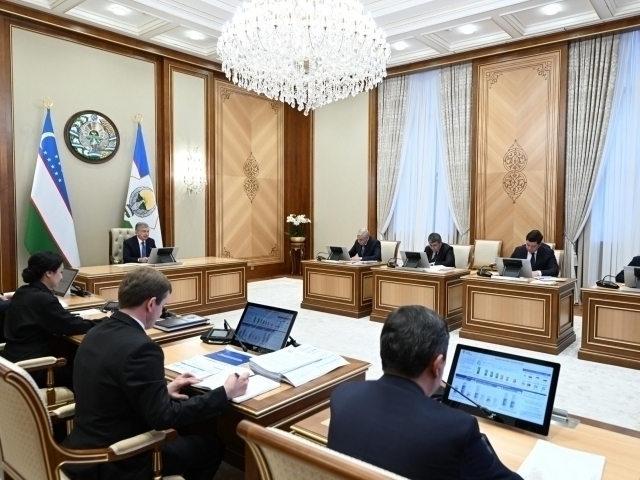
A Chamber of Court Administrators will be established in Uzbekistan to improve the efficiency of court administrators’ work. The matter was discussed on April 3 during a presentation to President Shavkat Mirziyoyev on new approaches to improving the insolvency system and restoring financially distressed businesses.
The country has been consistently working to develop private business, support entrepreneurs, and create more favorable conditions for them.
As a result of the reforms, Uzbekistan now has more than 300,000 sole proprietors and 5.5 million self-employed people. Over the past five years, the share of private business in the economy has increased from 45 percent to 58 percent.
This year, 140 trillion soums in loans are to be allocated to small and medium-sized businesses. Banks are also expected to channel $8 billion in external resources into neighborhood-level entrepreneurship, while 20 trillion soums will be allocated to regions to improve industrial, trade, and service infrastructure.
At the same time, it was noted that many issues remain unresolved when it comes to preserving existing businesses and jobs and supporting entrepreneurs facing financial difficulties at an early stage.
In particular, an upward trend has been observed in the number of inactive and liquidated small enterprises. This suggests that the current system is focused more on formally closing businesses than on preserving and restoring them.
First of all, insolvency procedures are not being applied sufficiently. Of the 93,000 entrepreneurs facing serious financial difficulties, insolvency proceedings have been initiated for only 10,000. The systems of pre-trial and court-supervised rehabilitation are not working effectively in practice. Over the past five years, rehabilitation procedures have been applied to only 68 companies, and only seven of them have managed to restore operations.
The work of court administrators was also critically reviewed. In a number of cases, procedural deadlines were violated, unfounded conclusions were issued, and mechanisms for timely identifying signs of fraudulent bankruptcy were found to be inadequate. Gaps in the payment system for court administrators have also hindered the recruitment of qualified specialists and, in some cases, encouraged the artificial prolongation of cases.
In addition, the sector remains undigitalized, with no online monitoring or oversight, no open registry of bankrupt or insolvent companies, and insufficient data exchange between state bodies.
In this regard, new institutional approaches were proposed to improve the effectiveness of public administration in the sector.
In particular, it was proposed to establish an Insolvency Affairs Agency under the Ministry of Justice. The new body would be responsible for implementing a unified state policy in the sector, coordinating the activities of state agencies, analyzing and addressing the causes of bankruptcy, and helping restore companies’ financial health.
To improve the efficiency of court administrators, it was also proposed to establish a Chamber of Court Administrators. The chamber would coordinate their work, organize professional training and advanced qualification programs, monitor compliance with legislation and professional ethics, and protect their rights and interests.
New financial mechanisms aimed at supporting financially distressed businesses were also presented.
In particular, for small and medium-sized businesses, support is planned through guarantees provided by the National Guarantee Company for Business and through the opening of low-interest credit lines at commercial banks via the Entrepreneurship Development Company to help restore companies’ financial stability.
Under the proposal, repayment of principal and interest on loans issued by commercial banks would be deferred until the completion of the rehabilitation process. The loans would then be repaid within three years after the rehabilitation is completed, and mechanisms would be created to allow for the restructuring of loan debt.
Special attention was also given to simplifying procedures for deferring and restructuring tax and loan debts.
In particular, district and city councils would be allowed to authorize deferred or installment payments for certain taxes. Similar mechanisms could also be applied by tax authorities on the basis of collateral, bank guarantees, or insurance policies.
State-supported pre-trial rehabilitation measures will also be expanded. These may include agreements with creditors, attracting financial assistance, deferring tax and loan payments, purchasing debt, repurposing production, reorganizing enterprises, hiring qualified specialists, and retraining employees.
The presentation also placed major emphasis on the digitalization of insolvency proceedings.
For this purpose, it was proposed to launch a unified electronic platform for managing insolvency cases. The platform would maintain registries of persons involved in insolvency proceedings, companies undergoing rehabilitation, and court administrators. All processes, from filing an application to liquidating a company, would be handled electronically. The system would also be open to the public and the media.
This would make it possible to ensure greater transparency in the sector, speed up data exchange, strengthen oversight and monitoring, and shorten the time needed to process applications.
The president stressed that supporting entrepreneurship should not be limited to creating new businesses. It is also necessary to preserve operating businesses, provide timely assistance to companies facing temporary difficulties, and help return them to economic activity.
Officials were given specific instructions to fundamentally improve the insolvency system on the basis of international experience and to introduce modern management practices, effective rehabilitation mechanisms, and digital solutions into the sector.

Live
All