Uzbekistan: Fewer in poverty, more sexual violence, rising pollution, and left powerless – Weekly Analysis
Review
−
26 July 2025 28509 20 minutes
In the first six months of this year, the birth rate in Uzbekistan has decreased significantly, and the number of deaths has increased. The number of births was 405.5 thousand. This is 14.4 thousand less than in the same period last year. The number of deaths is 84.1 thousand. This means that deaths are 2.7 thousand more than in the same period in 2024. Also, according to official data, in the first half of the year, the average salary in Uzbekistan approached 6 million soums. The poverty rate has decreased from 11 percent to 6.8 percent over the past seven months. So, is this true? How much do you earn? Have the poor and needy around you decreased?
15-year-old girl raped in Angren
Another minor girl was raped in Uzbekistan. This time, the case was detected in the city of Angren, Tashkent region. The girl is 15 years old and she was allegedly sexually assaulted by 4 young men.
It is not clear when the incident occurred, and the official authorities have been deliberately keeping quiet about it. In fact, on April 9 of this year, a criminal case was initiated by the Angren Department of Internal Affairs, and the Children's Ombudsman reported that preliminary investigations are still ongoing. I wonder what the responsible authorities have been conducting for more than three months as a preliminary investigation?!
According to the latest information, the Angren City Prosecutor's Office has established control over the investigation process. The Children's Ombudsman is conducting surveillance of the crime within its authority.
The girl was diagnosed with bronchopneumonia and anemia and was being treated in the hospital, and she was receiving psychological support. But this part of the news raises my doubts. It is not clear when the incident occurred, and it has been more than 3 months since the investigation began. Most likely, the situation was ignored, and the girl and her family were not provided with any help. If help had been provided at that time, the girl would have been in the hospital for 3 months. Either this situation was not reported to the republican authorities by local authorities as a big signal in time, or there is something else behind the case.
Initially, it was reported that the girl was being treated at the Angren Children's Hospital for diseases such as acute arthritis, bilateral bronchopneumonia, protein-energy malnutrition, severe anemia, and sepsis. These diseases are chronic, and none of them were caused by a criminal incident.
Shortly thereafter, Deputy Prosecutor General Isroil Adhamov and Deputy Minister of Health Elmira Bosithongova went to Angren, talked with the girl’s family members and doctors, and decided to transfer her to a specialized medical facility in Tashkent.
Meanwhile, Shahnoza Mirziyoyeva, First Deputy Director of the Social Protection Agency, who took special control of the situation, announced that penalties for violence against children would be further strengthened.
Mirziyoyeva said that the Criminal and Criminal Procedure Codes would:
- enhance punishment for persons who harm children;
- prohibit persons who commit violence from working with children for life;
Work is underway to introduce amendments to introduce a single procedure for rapid and effective accountability.
At this point, it is worth mentioning one issue separately: if, in fact, amendments are being made to the Criminal and Criminal Procedure Codes to strengthen penalties for violence against minors, then these changes should be considered separately for children of kindergarten age. We are witnessing the deaths of defenseless children who are being victimized by their upbringing in private kindergartens. One of their killers is released from prison in 6 years, the other in 3 years. And people's faith in justice and the court is fading, and the path to "samosuds" is opening. Of course, with the exception of deaths due to accidents, the death of children as a result of intentional injuries should already make the country's high and low officials think.
As for the girl who was raped in Angren, no agency has yet provided information about who committed the crime, whether a forensic examination was conducted, or whether the perpetrators were identified and detained in accordance with the procedural procedure. Is the lack of such information about the investigation a secret or because the hot spots for solving the crime have long since disappeared? This question is now open.
While this issue was being discussed, it was discovered that an Uzbek man had sexually assaulted one of the female passengers on a plane from Moscow to Tashkent.
The case concerns a 40-year-old citizen born in 1985. He repeatedly touched a female passenger during the flight and made inappropriate gestures. The woman warned him, but the man continued his actions despite this. The man's actions were witnessed by a flight attendant.
The man expressed remorse for his actions in court and said that he could not control himself because he was drunk.
Taking into account the man's social status, the court sentenced him to 3 days of administrative detention under Part 1 of Article 41 of the Code of Administrative Offenses (sexual misconduct). At the same time, the man was exempted from the costs of detention. This man has money to fly on a plane, drink, but he does not have money to pay for the costs of detention. He drinks, has sex with someone else's wife or daughter, gets imprisoned, and the costs of his detention are also borne by the public. Long live, man, long live!
We turn a blind eye to this situation on the plane, we let it go, but what about the doctors who are sexually harassing women and girls who have gone to the hospital in search of a cure for their ailments, and what should we say about their actions?
The fact is that on July 17 of this year, a 44-year-old doctor from the Tashkent regional branch of the Republican Scientific Research Institute of Emergency Medical Care entered the ward where a sick woman was being treated and, under the pretext of examining her, groped her. The doctor first closed the windows and doors, and then touched the woman's body several times. The documents on the case were submitted to the court, and the doctor was found guilty under Part 1 of Article 41-1 (sexual harassment) of the Code of Administrative Responsibility and was sentenced to 5 days of administrative detention. The doctor admitted his guilt in court, expressed sincere remorse for what he had done, and apologized to the patient and her family.
What is happening to us, to our nation? If he rapes a minor girl, if he screams and plays with lust at a woman sitting next to him on an airplane, if he does not know how to control himself after drinking alcohol, if doctors make eye contact with women who come to him for treatment? What kind of nation, what kind of society is this? Is there an end to all this? It is as if we live in a forest and are surrounded by people with blood all around us. As a son, brother, father, and husband, I do not agree that women should be punished for their immorality with 3 or 5 days of administrative detention. Hey, we talked about women's rights, we talked about gender equality, we talked about protecting children from all forms of violence, we talked about fighting sexual violence against minors. Is our struggle so empty, is our determination so weak? What are we waiting for, what are we afraid of? Those who corrupted someone else's beautiful daughter and ruined her life are walking around with their mouths in their ears and their feet on the ground. Those who lusted after someone else's woman, who is their honor, are getting away with it with excuses. Those who killed a child and brutally beat her are getting less punishment than thieves. Is this justice? I don't agree with this justice?
Inappropriate behavior by official in Samarkand sparks outrage
Would you believe that thoughtlessness, shamelessness, and a lack of professionalism have infiltrated some government departments—so much so that a few officials have turned their taxpayer-funded offices into personal playgrounds?
This week, disturbing footage surfaced on social media showing an official from the Department of Poverty Reduction and Employment in the Samarkand region acting inappropriately with a woman, reportedly a colleague, during a Zoom meeting. In the video, the man can be seen hugging the woman and pulling her onto his lap, seemingly forgetting the camera was still on. Other participants witnessed the inappropriate conduct in real time and managed to record it.
The Ministry of Poverty Reduction and Employment responded with a brief statement. While it confirmed that the employment contracts of both individuals involved had been terminated, it failed to name the employees or specify the location of the incident.
According to reports circulating on social media, the man had been serving as the head of the Poverty Reduction and Employment Department in Kattakurgan district since December 2023.
The ministry reiterated its “zero-tolerance” policy for violations of workplace ethics and discipline. But one must ask: what does zero tolerance actually mean in practice? Is this a warning to avoid such behavior only when cameras are rolling? Why are repeat offenders simply allowed to leave the system quietly? If internal controls were truly effective, would such incidents still be happening?
It’s worth noting that this is not an isolated case. In April this year, the deputy head of the Andijan Department for Poverty Reduction and Employment Promotion was caught using marijuana in his office. Had strict and transparent action been taken then, perhaps this latest scandal could have been avoided.
Toxic smoke blankets Almazar and Navoi
On the night of July 21, toxic smoke blanketed large parts of Tashkent’s Almazar district, alarming residents and sparking rumors of an explosion. The dense fog-like smoke appeared around midnight, spreading quickly and prompting concern across social media.
By dawn, the Ministry of Emergency Situations confirmed that the air on Uzumbag Street carried a strong chemical odor resembling that of match sulfur. In response, specialized units from the Federal Emergency Management Agency’s Radiation, Chemical, and Medical-Biological Protection departments were dispatched to the area.
Initial reports indicated that hydrogen peroxide had leaked into the air from a container stored in a warehouse. However, officials failed to clarify whether there had been an explosion, how many individuals were affected, or what immediate medical assistance had been provided.
The Ministry stated that an investigation was underway, but nearly a week later, no results have been disclosed. Key questions remain unanswered: How much hydrogen peroxide leaked? What damages were caused? Who owns the warehouse? What exactly led to the incident?
According to officials, the situation was contained by 4:00 AM. Still, the lack of transparency continues to worry the public.
Just two days earlier, on July 19, residents of Navoi city reported a thick, dusty smoke hanging over the region. Environmental monitoring revealed hazardous levels of pollutants: ammonia was 1.4 times above the acceptable limit, and hydrogen sulfide a staggering 16.8 times higher. Carbon dioxide and ammonia levels also exceeded norms at two separate observation posts.
Many on social media blamed the emissions on Navoiyazot JSC, a major chemical enterprise in the region. However, the company denied any involvement, claiming the smoke had drifted in from the western part of the city near Navoi International Airport.
To back its claim, Navoiyazot installed a surveillance camera at its ammonium nitrate workshop and released footage showing the smoke coming from the site of the former Navoi Electrochemical Plant. The company said it was cooperating with the Regional Council of the Ecological Party to identify the true source of the pollution.
Yet, despite this investigation, authorities have not publicly disclosed any actions taken against the polluting enterprises or clarified their activities. Instead, the Navoi regional administration focused its efforts on public relations, airing explanations via the local Navoi TV channel.
Meanwhile, state-run national channels like "Uzbekistan 24" remained silent on the issue. Local journalist Rukhsora Bobokulova of the Navoi regional TV and radio channel did address the matter during her morning program—after which, the channel mysteriously went off the air.
Social media users speculated that Bobokulova was being harassed for speaking out. The regional administration denied these claims, saying that broadcasts were merely paused due to technical upgrades, including the installation of an LED screen. They stated that live programming resumed on July 24.
Authorities also claimed that Bobokulova faced no pressure and continues her journalistic work. But the incident has left many questioning the true state of press freedom and accountability in the region.
Forest fires have increased
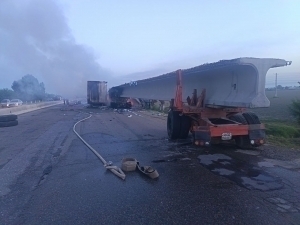
This week has also been marked by numerous accidents and fires. In addition to the burning of buses and cars, forest fires seen in other countries have now reached Uzbekistan.
On July 23, a fire broke out in the Surkhan State Reserve. According to the Fire Department, the blaze ignited in dry grass and was extinguished after nine hours. No injuries or fatalities were reported.
That same day, a house and a building materials store caught fire in the Kibray district of the Tashkent region. The fire was reportedly caused by a lightning strike. In both cases, the Fire Department did not disclose the size of the affected area or the extent of the damage.
On July 24, a fire broke out over two hectares in the Bostanlyk district of the Tashkent region. Smoke from the blaze was visible as far away as the capital, Tashkent. It took 6.5 hours to extinguish the fire, and a helicopter was reportedly deployed in the effort. A similar incident occurred on the same day in the Mirzo Ulugbek district of Tashkent, where dry grass and brush caught fire in an open area on Anaybulok Street.
Many fires are attributed to extreme heat, power outages, and high-voltage electrical issues. However, there has been no official analysis in Uzbekistan addressing these causes. Data on fires triggered by electrical surges, their consequences, and compensation procedures continue to be neglected by authorities.
Tashkent has experienced widespread power outages over the past week. Social media has been flooded with complaints about unannounced blackouts, with some residents reportedly without electricity for 8–10 hours. These outages have caused household appliances to break down. Despite the growing public outcry, the authorities responsible for electricity supply have remained unresponsive.
The Almazar district has been particularly affected by these shutdowns. Actor Mehriddin Rahmatov, a resident of the district, publicly addressed the issue.
His video message echoes the frustration of many Tashkent residents. While not everyone can speak out on social media, it is clear that the problem of power outages extends far beyond individual homes, streets, or neighborhoods. The question remains: what is the situation in your area?
Mubashshir Ahmad case brought to court
The criminal case against Mubashshir Ahmad (real name Alisher Tursunov), a religious scholar, blogger, and founder of the analytical portal Azon Global, has been completed and forwarded to court. This was reported by his lawyer Ruslan Sodikov via Facebook.
A criminal case was initiated against Tursunov on August 11, 2023, under Article 244-3 of the Criminal Code (illegal preparation, storage, import, or distribution of religious materials). According to his lawyer, such an act qualifies as a crime only if it follows a previous administrative penalty for the same violation. However, Tursunov was administratively charged without clear documentation of this prerequisite.
Uzbek law stipulates that religious materials may be produced, stored, and distributed only with approval from the Committee for Religious Affairs. The first violation is subject to administrative penalties; repeated violations within a year can result in criminal charges.
According to the defense, in 2023, Mubashshir Ahmad was administratively penalized for distributing religious content on his “Azon TV” channel without obtaining prior approval. Later that year, the case was treated as a repeat offense, leading to criminal prosecution. The lawyer stated that Ahmad was unaware of the charges and the issuance of a search warrant while he was residing in Turkey.
On November 10, 2023, a petition was filed to impose preventive detention in absentia against Ahmad. The court denied the request the same day, allowing the case to proceed with a good behavior agreement, and the criminal investigation was closed.
However, on May 11, 2025, Ahmad was arrested and subsequently charged under Article 244-1, Part 3, Subparagraph "g" of the Criminal Code. According to his lawyer, Ahmad requested the assistance of private counsel during interrogation and investigation but was denied this right. As a result, he refused to sign investigative documents.
“The defense contacted the investigator multiple times and even sent messages, but was ignored. The investigator proceeded to file charges and request detention using a state-appointed lawyer.
The charges stem from a video titled "What does the fatwa of the scholars on jihad against Israel mean?" posted on Ahmad’s Telegram channel. The court’s decision to prosecute was based solely on the Committee for Religious Affairs’ conclusion that the content contained extremist ideas. No independent expert analysis regarding the material’s intent or criminal elements was presented,” said the lawyer.
On May 14, 2025, the case was transferred to the Investigation Department of the State Security Service of Uzbekistan. Ahmad reported that, contrary to expectations, he was treated respectfully during pre-trial detention, without physical or psychological pressure.
During the investigation, content from Azon Global and affiliated social media channels was reviewed. The authorities concluded that no crimes against the Republic of Uzbekistan or serious offenses against peace and security were found.
However, in materials related to the Israeli-Palestinian conflict, experts reportedly found elements suggesting incitement to ethnic, racial, or religious hatred. Based on this, an additional charge under Article 156, Part 2 of the Criminal Code was added.
The defense argues that since Ahmad was working from Turkey, Uzbek regulations requiring permission from the Committee for Religious Affairs should not apply. Furthermore, the lawyer raised concerns about the expert examinations and the legal basis for the charges.
“We will fully exercise our legal rights to ensure that the principles of adversarial proceedings and truth-seeking, as outlined in the Criminal Procedure Code, prevail over questionable expert assessments of incitement-related charges,” the lawyer stated.
Uzbek national who insulted the President detained in Azerbaijan
Uzbek citizen Omonbek Yusupov, accused of humiliating the honor and dignity of Uzbekistan’s President Shavkat Mirziyoyev, was detained in the Azerbaijani capital Baku and extradited to Tashkent.
The 43-year-old Yusupov had been placed on an international wanted list and was arrested in Azerbaijan in April this year. He was taken into custody as a preventive measure.
Under the Convention “On Legal Assistance and Legal Relations in Civil, Family and Criminal Matters,” adopted on October 7, 2002, a decision was made to extradite the accused. He was handed over to Uzbek authorities under the escort of a special convoy from the Azerbaijani Ministry of Justice’s Penitentiary Service.
According to amendments to Article 158 of the Uzbek Criminal Code, made on March 30, 2021, public insult or slander against the President of Uzbekistan—including via the press, mass media, telecommunications networks, or the internet—is punishable by up to three years of correctional labor, two to five years of restricted liberty, or up to five years of imprisonment.
Doctor amputates healthy leg in Fergana
Public dissatisfaction with Uzbekistan’s healthcare system is on the rise. Complaints include deaths in public and private hospitals, low-quality services, botched surgeries, and rising maternal and infant mortality—issues often attributed to systemic corruption in the sector. Even official reports cite healthcare as the most corrupt area in the country.
In a recent incident, the head of the Surgery Department at the Fergana branch of the Republican Specialized Endocrinology Center amputated both legs of a patient instead of only the injured left leg—ultimately causing the patient’s death.
On October 18, 2024, the patient was admitted to the facility by his children. He was diagnosed with severe type 2 diabetes mellitus in the decompensation stage, neuroischemic type of diabetic foot syndrome (DTS), Wanger stage 4, post-amputation condition of the left lower leg, and a comminuted knee fracture.
At the time of admission, the head of the department was on vacation. His responsibilities had been temporarily assigned to another doctor.
Despite being on leave, the department head removed the temporary replacement from the case, deeming them inexperienced, and personally performed the surgery without formal medical indication. He drafted a surgical plan for amputation of the left thigh and issued it under the temporary doctor's name.
On October 19, the operation was conducted by the vacationing doctor, assisted by staff and students not specialized in the procedure. During the surgery, the patient’s right, healthy leg was mistakenly amputated. The left leg was amputated later—again, without obtaining consent from the patient’s family.
Following these two invasive surgeries, the patient died on November 7, 2024.
On May 6, 2025, the Kuva District Court found the doctor guilty under Article 116, Part 3 of the Criminal Code (improper performance of professional duties), sentencing him to four years in prison. Additionally, under Article 45 (deprivation of certain rights), he was banned from working as a medical manager or practitioner for three years.
The Fergana Regional Court of Appeal reviewed the case. The doctor argued that his actions were not criminal and that the patient’s death was unrelated to his surgery, requesting acquittal. However, the appeal was denied, and the initial verdict upheld.
State Security Chairman visits Afghanistan
The Chairman of Uzbekistan’s State Security Service, Colonel General Bakhodir Kurbanov, visited Kabul and held a series of meetings with officials of the Taliban’s interim government.
In a meeting with Acting Defense Minister Mullah Muhammad Yaqub, the Uzbek delegation expressed support for Afghanistan’s progress in national security and economic development, emphasizing the importance of strengthening bilateral ties.
The Taliban official praised Uzbekistan’s constructive international approach to Afghanistan and noted the growing cooperation between the two countries. The sides discussed border cooperation, communication channels, and other key issues.
In a separate meeting with Abdul Haq Wasiq, head of the Taliban's Intelligence Service, talks focused on regional peace and stability, along with efforts to integrate Afghanistan into international systems.
Discussions also covered safeguarding the Uzbekistan-Afghanistan border, improving cross-border procedures, and combating drug trafficking and terrorism.
This visit continues a series of diplomatic engagements between Tashkent and the Taliban over the past three years. Key Uzbek officials such as Sardor Umurzakov, Ismatulla Irgashev, and Bakhtiyor Saidov have also visited Kabul and engaged in high-level talks.
On July 3, 2025, during the Economic Cooperation Organization summit in Khokand, Uzbek President Shavkat Mirziyoyev met with Mullah Abdul Ghani Baradar, the Taliban’s acting Deputy Prime Minister for Economic Affairs. On the same day, Russia became the first country to officially recognize the Taliban’s interim government.

Live
All