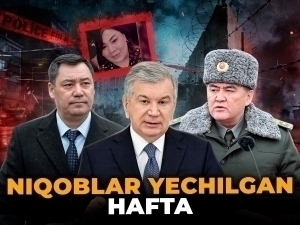
Child deaths, Epstein’s Uzbek “girlfriend,” and murders — Weekly analysis
Review
−
08 February 4428 8 minutes
A father was arrested for killing his one-year-old daughter. The man claims that the child died due to medical error. He is even willing to allow the exhumation of his daughter’s grave. Meanwhile, fraud is on the rise, and the personal data of 15 million Uzbeks may have been sold. What is the cost of such data? In another case, a man stabbed his brother for sending a text message to his sister. Additionally, a Samarkand official faced consequences after sending his own children abroad on the state budget instead of talented students.
This week, several tragic events involving four Uzbek girls drew public attention. We will examine each case in sequence. The most shocking incident occurred in Fergana, where a father stabbed his one-year-old daughter to death. Discussing the actions of a father is always sensitive. Biologically, many people may bear the title “father,” but not everyone truly fulfills the responsibilities of that role. Unfortunately, there is ample evidence proving this.
Court documents indicate that a dispute between the man and his wife escalated into an argument. During this conflict, the man allegedly sought revenge on his wife by stabbing his defenseless child. The girl was taken to the hospital and received urgent medical care but ultimately became a victim.
The case was heard at the Kokand City Court for Criminal Cases. The 31-year-old man was sentenced to 17 years in prison under Article 97, Part 2, Clause “v” of the Criminal Code of Uzbekistan, for intentional homicide.
While the Fergana case involved a father taking his daughter’s life, a man in Kashkadarya is willing to allow the exhumation of his nine-year-old daughter’s grave. He hopes to prove that his child died due to medical negligence rather than illness.
According to QALAMPIR.UZ, a resident of Qamashi village, Kasbi district, contacted the publication. The man claims that in 2016, doctors at Polyclinic No. 8 incorrectly administered an antibiotic injection, which resulted in his daughter’s death.
Examining the expert reports reveals significant contradictions: the first report cites a gastrointestinal cause of death, the second mentions a heart condition, and the third lists liver cirrhosis.
The child’s father strongly rejects these conclusions, stating that his daughter was healthy and only visited the clinic due to a stomachache after eating a banana and drinking water. In light of these events, Zohidjon Baratov expressed willingness to exhume his daughter’s grave so the responsible parties could face justice.
Hayot Shamsutdinov, press secretary for the General Prosecutor’s Office, told QALAMPIR.UZ that pre-investigation checks were conducted by the Kasbi district prosecutor’s office. On August 30, the authorities decided not to open a criminal case under Article 83, Part 2 of the Criminal Procedure Code (grounds for rehabilitation).
However, after QALAMPIR.UZ began investigating, the decision and collected documents were reviewed, and on February 2 this year, the decision not to open a criminal case was annulled. Additional pre-investigation measures were initiated.
Another tragic case involved a fire that claimed the life of a three-year-old girl. On January 31, thick black smoke from a fire at the “Aviator” shopping and entertainment center in Yashnobod district filled the sky over Tashkent, sending shock through the nation.
Investigators spoke with witnesses, who highlighted serious safety violations. The fire started in the ceiling of the children’s playground. Initially, there was a small spark, but many continued with their activities, unaware of the growing danger. One anonymous witness said the building quickly filled with smoke, making visibility nearly impossible. Parents rushed inside to rescue their children, while the children panicked. Another witness noted that fire sprinklers did not operate and emergency exit signs were absent. The building was inadequately prepared for such incidents.
On February 2, a criminal case was opened for “abuse of authority by officials of a non-governmental or other organization” and “violation of fire safety rules.”
The tragedy raised public concern about visiting entertainment and shopping centers. On February 5, the state fire safety authorities conducted inspections in Tashkent of crowded buildings.
The results were alarming: in seven districts, ten shopping and entertainment complexes were found to have severe fire safety violations. These issues posed a serious threat to human life. Operations were temporarily suspended until all violations were fully addressed.
Stronger oversight is positive, but must people suffer before such measures are taken? Questions remain.
Shifting to international crime, recently released Epstein documents have shocked the world. Among them, it was revealed that an Uzbek citizen had been in contact with Epstein.
The girl, 19 at the time, communicated with Epstein via email and Skype. She lived in difficult conditions, often ate only two meals a day, and had been physically abused by her parents. She aspired to study abroad in Malaysia or the United States, change her life, and pursue modeling. Documents show that Epstein also prepared her for meetings with his associates, expecting her to present a certain appearance.
Images of her messages stating, “I am doing my best to please you and your friends. No makeup, nothing on my nose,” were released. Epstein reportedly sent her $25,000 and covered her travel expenses.
The release of this information has provoked mixed reactions in Uzbek society. Some criticize her, some try to understand her situation. But it is important to remember: Epstein was a major criminal, and all girls and women he contacted were victims.
QALAMPIR.UZ confirmed that the girl previously lived in Chilonzor district, studied e-commerce at Westminster University in Tashkent and Staffordshire University in Kuala Lumpur, completed a film directing course in Paris, and worked as a regional manager, translator, and English tutor.
Journalist Aziza Qurbonova located her social media profile and reported that she now lives a peaceful life in Uzbekistan.
Meanwhile, the leak of Uzbek citizens’ personal data is causing concern. On February 3, reports emerged that the personal data of over 15 million Uzbeks had been posted on the Darknet. The data, collected during the January 15–31 population and agricultural census, raised questions about accountability and security. The Statistics Committee confirmed that all collected data is stored securely on encrypted servers, with no photos of individuals included.
Still, some representatives of the public remain skeptical. Questions about responsibility, consequences, and risk levels remain. QALAMPIR.UZ prepared an analytical article titled “Your Data is Being Sold,” which references past incidents of a 15-year-old hacking the Senate website.
In other news, during the Senate plenary session, Senator Abdusaid Kochimov strongly condemned Russian propagandists, emphasizing the defense of national interests.
In foreign policy, on February 5, President Shavkat Mirziyoyev visited Islamabad, Pakistan. Pakistani fighter jets escorted his plane through the country’s airspace, signaling high diplomatic respect. The Uzbek president met with Pakistani leaders, discussed strategic partnership, and oversaw a ceremony naming a street and park after Zahiriddin Muhammad Babur. Mirziyoyev was awarded honorary titles from Pakistan’s National University of Science and Technology and received the Nishan-i-Pakistan award.
Ongoing diplomatic activity highlights Uzbekistan’s growing global engagement. On February 4, Saida Mirziyoyeva spoke at the “Human Fraternity” global forum in Abu Dhabi, attended by 150 high-ranking international guests, including Nobel laureates, heads of UN agencies, and Gulf region leaders.
Domestically, the issue of talented students being replaced by relatives of officials persists. In Samarkand, the head of the Preschool and School Education Department sent his son and nephew on a trip abroad meant for gifted students. Social media criticism followed, and an investigation confirmed misuse of state funds. The Anti-Corruption Agency reported that 28 million soums were returned to the local budget.
Cases of school violence abroad have also surfaced. On February 3, a 15-year-old in Russia opened fire on classmates and teachers with a pneumatic weapon. On February 6, a student in Azerbaijan shot a teacher, while in Kazakhstan, a tenth-grader attacked classmates with an axe. These incidents highlight the fragility of youth behavior.
Back in Uzbekistan, a man stabbed another for sending inappropriate messages to his sister. The 28-year-old, upon returning from Russia, attacked his neighbor in July 2025, resulting in serious but non-fatal injuries. He was sentenced to seven years in prison.
Crime statistics indicate rising trends. In 2025, 23,973 youth were convicted of crimes, with Tashkent city and region showing the highest rates. Among youth, theft, vandalism, robbery, and assault were the most common offenses.
Family disputes are also increasing, from 119,000 in 2024 to over 134,000 in 2025. Mediation efforts have helped some families, though concerns about effectiveness remain.
On a positive note, Uzbekistan may soon hold individuals accountable for social media offenses, including posting offensive content to gain followers. The Legislative Chamber’s “National Revival” faction has discussed amendments to the Administrative Code to address such violations.
These measures aim to encourage responsible behavior online, reducing misuse of social networks and “prank culture.”
Nurzodbek Vohidov

Live
All