Putin lost the “battle.” Russia intends to stay long in Central Asia – results of the Dushanbe summits
Review
−
11 October 10822 11 minutes
International law has become so weakened today that even countries like Tajikistan are failing to meet its obligations. This shows that moderately developed, wealthy, and powerful nations need not feel offended by criticism. Tajikistan ratified the Rome Statute of the International Criminal Court (ICC) back in 2000 but did not fulfill its obligations under the treaty, without any official explanation or warning. As many know, the Rome Statute requires its member states to arrest and hand over individuals for whom the ICC has issued arrest warrants. However, Mongolia in 2024 and Tajikistan in 2025 failed to comply with this obligation regarding President Vladimir Putin, against whom the ICC issued an arrest warrant in 2023. Both Ulaanbaatar and Dushanbe ignored the court’s demand.
That issue aside, let us turn to the events of October 8–10, when Tajikistan hosted two major political gatherings — the Central Asia–Russia Summit and the next meeting of the CIS Council. This year, both events were held back-to-back in Tajikistan without any break. One of the most notable developments was the apparent “reconciliation dinner” between Putin and Aliyev, which became not only the highlight of the day but perhaps of the entire year. Relations between Baku and Moscow had remained frosty since December 2024, and tensions further escalated over the summer. The dispute revolved around Azerbaijan’s demand that Putin personally apologize publicly for the crash of the AZAL aircraft and compensate for the damage. The “arrogant” Kremlin had long resisted this demand, but Aliyev eventually achieved his goal — Putin had to yield.
The latest Central Asia–Russia summit and the CIS meeting also brought forward several important proposals, documents, and integration initiatives. For instance, the European Union criticized Tajikistan for not arresting Putin. However, within the EU itself, Hungary had earlier declared it would not detain Israeli Prime Minister Benjamin Netanyahu, revealing double standards. During the summit, Uzbekistan’s President Shavkat Mirziyoyev proposed developing an energy partnership program between Moscow and Central Asian countries and suggested addressing persistent transport issues within the CIS framework. Putin, for his part, recalled that Russia had allocated $33 million for projects related to the Aral Sea as well as the Amu Darya and Syr Darya rivers. Yet, he did not mention the system responsible for the ongoing water crises. Additionally, in exchange for conceding to his Azerbaijani counterpart, Putin managed to secure the release of the “Sputnik Azerbaijan” editor detained earlier this summer.
The summits, attended by nine leaders, also stood out for the CIS’s partial integration with the Shanghai Cooperation Organisation (SCO), in which the CIS obtained observer status.
Today, we will take a closer look at the three days of political events that unfolded in Tajikistan.
Putin was not arrested
The “Central Asia–Russia” summit in the C5+1 format differs from other partnerships and gatherings. Central Asian states also have similar cooperation formats with Germany, Japan, and the European Union. However, unlike with Russia, they do not have to demand respect from these partners, nor remind them that they are no longer colonies. Yet, with Russia, such reminders still seem necessary — as seen three years ago when Tajik President Emomali Rahmon “put Putin in his place” at the Astana summit.
“We want to be respected. We are not beggars. We are a wealthy country with more mineral resources than listed in Mendeleev’s periodic table. We have always respected Russia’s strategic interests, but Russian businessmen are only interested in oil and gas. We deserve respect. Are we some sort of outsiders? You don’t need to spend much money on us. Vladimir Vladimirovich, I ask you not to treat Central Asian countries as former Soviet republics,” Rahmon said at the 2022 Astana summit.
That episode made the Central Asia–Russia summits memorable for their tensions. However, this time in Tajikistan, everything proceeded smoothly. No disputes occurred among the leaders, and Putin was warmly welcomed. From the standpoint of international law, Tajikistan should have arrested him — but which “international law” are we referring to? Although Tajikistan ratified the ICC’s Rome Statute 25 years ago and was technically obliged to surrender Putin for alleged crimes against humanity, the world has changed. The old rules no longer hold. Today, even countries like Mongolia and Tajikistan freely violate such protocols. Since acts of violence against civilians have been reframed as “self-defense” in recent years, ignoring ICC demands is no longer viewed as shameful or unlawful. Instead of executing the ICC arrest warrant, Dushanbe chose to receive Putin with full honors. The European Union, in turn, accused Tajikistan of failing to comply with the ICC’s obligations.
Compensation for Soviet-Era damage?
On October 9, Dushanbe hosted the second Central Asia–Russia summit chaired by President Emomali Rahmon. The meeting was attended by Uzbekistan’s President Shavkat Mirziyoyev, Russia’s President Vladimir Putin, Kazakhstan’s President Kassym-Jomart Tokayev, Kyrgyzstan’s President Sadyr Japarov, and Turkmenistan’s President Serdar Berdimuhamedov.
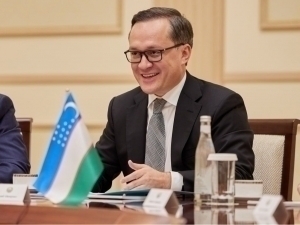
President Mirziyoyev emphasized that cooperation in the energy sector with Russia would remain a key factor for regional stability. He noted that this partnership was developing rapidly and proposed several initiatives.
During the summit, Vladimir Putin urged his counterparts to strengthen ties with the Taliban — a movement recognized only by Russia so far. He said many terrorist groups in Afghanistan are spreading extremist ideas, while Russia supports the Taliban’s temporary government in its efforts to combat terrorism. Uzbekistan was among the first countries to engage in dialogue with the Taliban and continues to cooperate today. At the subsequent CIS meeting, President Mirziyoyev again raised the issue of Afghanistan, warning that it remains a potential source of threat to the region and insisting on the need for peace and stability there.
Putin also reminded participants that Russia had allocated over $33 million to Central Asian countries for monitoring the Amu Darya and Syr Darya basins, introducing water-saving technologies, and planting forests around the Aral Sea. However, he did not specify how exactly this money was used. Since Russia identifies itself as the successor to the Soviet Union, its legacy includes both the positive and negative aspects of the USSR’s past. Given that it was the Soviet Union that once drained the Aral Sea, this $33 million can be seen as a form of compensation — as it is difficult to define it otherwise.
Putin surrendered
Aliyev and Putin have finally reconciled — and it happened only after Putin bowed to pressure. Their face-to-face meeting in Dushanbe was their first full interaction since the AZAL plane was shot down near Grozny and later crashed near Aktau. Although they briefly met during the SCO summit in China, Kremlin spokesperson Dmitry Peskov described that meeting as “non-substantive.” The Dushanbe talks took place just after the Central Asia–Russia summit and before the CIS Council meeting.
During the meeting, Putin appeared tense, short of breath, and visibly uncomfortable — a sharp contrast from his usual confident demeanor. A few years ago, it would have been unthinkable that Aliyev’s determination and composure could humble the Russian leader. But the world is changing rapidly: even Putin can now be made to apologize and comply with demands.
Ultimately, Putin agreed to all three of Azerbaijan’s conditions — he apologized, pledged to punish those responsible, and promised compensation.
The meeting began with a discussion of the plane crash that occurred at the end of 2024. Putin blamed Ukrainian drones but admitted that Russian missiles may have exploded a few meters from the aircraft, indirectly causing the damage. He said the crew was advised to land in Makhachkala but chose to continue toward their base airport. Putin stated that a legal assessment would be given to all officials involved and reiterated his condolences to the families of the victims. He said Russia was ready to fully cooperate in the investigation and pay compensation.
In addition, both sides began releasing detainees captured during the summer. Azerbaijan freed “Sputnik Azerbaijan” editor Igor Kartavikh, while Russia released an Azerbaijani citizen in return. These negotiations were mainly held between presidential aides — Yuri Ushakov and Hikmet Hajiyev — prior to the Putin-Aliyev meeting.
“The issue is closed”
In Dushanbe, Putin held his usual standing press conference for Russian media. He spoke mainly about his reconciliation with Aliyev and criticized the Nobel Committee for not awarding the Peace Prize to Donald Trump. When asked whether the crisis in bilateral relations had been fully resolved, Putin said it had never been a true state-level crisis but rather one driven by emotions.
“You know, I wouldn’t call it an intergovernmental crisis. Why? Because if it had been, trade relations would have declined. But despite everything that happened, trade continued to grow significantly. So I’d say it was more of an emotional crisis — and understandably so. We faced a very tragic incident, the plane crash. We just needed time to process and understand it calmly. I’d also like to note that Azerbaijan is practically a Russian-speaking country — the Russian language is studied everywhere. This shows the deep and stable nature of our relations. I believe it will stay that way. Emotions are inevitable, but they should never hinder progress. I hope all this is behind us,” Putin said.
The Russian president also spoke about former U.S. President Donald Trump’s failed bid for the Nobel Peace Prize, criticizing the committee’s inconsistency.
“There have been cases when the Nobel Committee awarded the Peace Prize to people who did absolutely nothing for peace. In doing so, they damaged the prestige of the award. Some people receive it just months after taking office — for what, exactly? Such honors should be based on achievements. I know for a fact that Trump has genuinely tried to resolve the crisis in Ukraine and promote peace. Whether everything worked or not, that’s another question. But he made real efforts. Look at the Middle East — if Trump manages to achieve what he’s pursuing there, it will be a historic event,” Putin said.
Belarusian President Alexander Lukashenko shared a similar sentiment, saying it was “nonsense” that former U.S. President Barack Obama received the Nobel Peace Prize while Trump did not.
“Trump deserved the Nobel Prize. It’s pure absurdity. Obama got it for doing nothing, while Trump made serious efforts toward peace. The prize should have gone to him,” Lukashenko said.
Later, Donald Trump posted a video clip on his social media page showing Putin’s remarks about the Nobel Prize, thanking the Russian president for his words.
The CIS expands
The CIS summit chaired by Tajikistan’s President Emomali Rahmon was attended by Uzbekistan’s President Shavkat Mirziyoyev, Azerbaijan’s President Ilham Aliyev, Belarus’s President Alexander Lukashenko, Kazakhstan’s President Kassym-Jomart Tokayev, Kyrgyzstan’s President Sadyr Japarov, Russia’s President Vladimir Putin, Turkmenistan’s President Serdar Berdimuhamedov, Armenia’s Prime Minister Nikol Pashinyan, and CIS Secretary General Sergey Lebedev.
The meeting concluded with the signing of several agreements and policy documents outlining the CIS’s future priorities. The chairmanship was handed over to Turkmenistan’s President Serdar Berdimuhamedov. A total of 19 documents were signed, including a cooperation program on strengthening border security from 2026 to 2030, a declaration on ensuring regional energy security, a document establishing the “CIS Plus” format, and a decision granting the CIS observer status in the Shanghai Cooperation Organisation.
Of particular note was the “CIS Plus” format, designed to expand cooperation between core CIS member states and third countries, as well as international organizations. This format will allow such countries and organizations to participate in CIS events, meetings, and platforms. The aim is to expand collaboration in areas such as the economy, security, energy, and transport logistics. However, it remains unclear how the CIS’s observer status in the SCO will benefit its members or what practical advantages it will bring.
Live
All