First “Central Asia–Italy” summit yields joint declaration on regional cooperation
World
−
30 May 4579 5 minutes
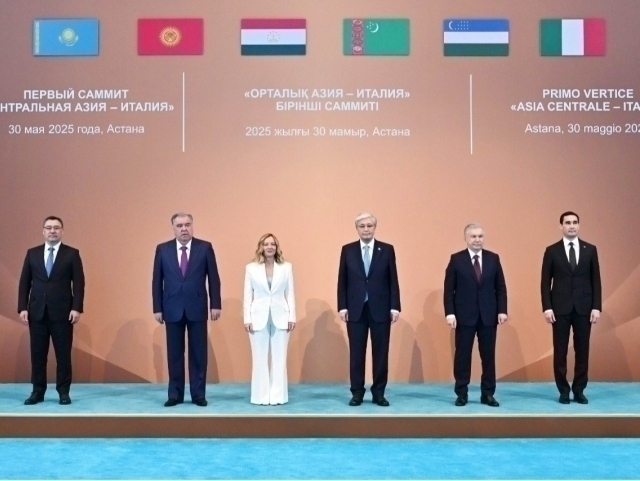
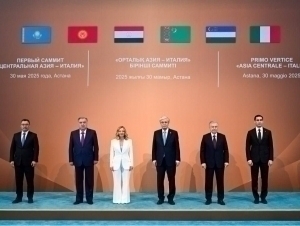
On May 30, the first Central Asia–Italy summit was held in Astana, Kazakhstan, where a Joint Declaration was adopted. The full text of the document was published on the official Akorda website.
According to the document, the leaders noted the progress achieved since the third Central Asia–Italy Ministerial Conference in Rome in 2024 and reaffirmed their commitment to strengthening a partnership based on shared values, mutual respect, and common interests. It was highlighted that bilateral cooperation between Central Asian countries and Italy, along with interactions within the European Parliament and other multilateral platforms, is expanding.
The head of the Italian government expressed support for the efforts of Central Asian countries to deepen regional cooperation. In this context, it was noted that consultative meetings of Central Asian heads of state play a vital role in promoting regional collaboration, multilateralism, peace and stability, sustainable development, and addressing common challenges.
The leaders welcomed the signing of the Treaty on the State Border between the Kyrgyz Republic and the Republic of Tajikistan on March 13, 2025, as well as the agreement on the point of contact of state borders between Kyrgyzstan, Tajikistan, and Uzbekistan. These developments were seen as positive steps toward regional peace and prosperity.
The summit also welcomed the intensification of relations between Central Asia and the European Union. The EU Strategy for Central Asia and the joint “Roadmap” developed in 2023 were noted as significant tools for deepening these relations. The 20th Central Asia–EU Ministerial Meeting held in Ashgabat on March 27, 2025, and the first Central Asia–EU Summit in Samarkand on April 3–4, 2025, were highlighted as major milestones in elevating strategic partnerships and enhancing regional ties.
Leaders highly appreciated ongoing cooperation within the framework of the United Nations and its specialized agencies. They voiced support for Italy’s initiatives in security, environmental protection, and infrastructure, along with activities promoting innovation and regional collaboration.
All participating leaders expressed their intention to cooperate in the areas of peace, security, democracy, human rights, the rule of law, and sustainable development. They reaffirmed their commitment to the principles of the UN Charter, including respect for independence, sovereignty, and territorial integrity of states, protection of human rights and fundamental freedoms, renunciation of the threat or use of force, and peaceful resolution of international disputes.
“Readiness was expressed to discuss cooperation opportunities in line with Italy’s strategic approach within the Mattei Plan to ensure sustainable development on the African continent,” the document states.
The importance of addressing global threats was also emphasized. In particular, the leaders agreed to enhance cooperation in combating climate change, terrorism, cyber threats, extremism, illegal migration, and the trafficking of narcotic drugs, psychotropic substances, and their precursors, including fentanyl.
Interest was expressed in strengthening cooperation between law enforcement agencies, preventing extremism, supporting deradicalization efforts, and expanding collaboration in information exchange, knowledge-sharing, and skills development.
The document notes the steady growth of economic ties between Central Asia and Italy, and a shared commitment to deepening cooperation in trade, investment, and the development of small and medium-sized enterprises.
Measures were discussed to enhance cooperation not only in natural resources but also in areas such as climate, energy (including renewable sources like solar, wind, and hydropower), critical raw materials, agriculture, infrastructure, and under the European Union’s “Global Gateway” strategy.
Initiatives addressing the Aral Sea crisis, melting glaciers, sustainable development in mountainous regions, and efficient water resource technologies were welcomed. Italy’s involvement in environmental projects and the recognition of Central Asia’s potential in renewable energy and hydrogen production were highlighted.
The issue of developing the Trans-Caspian International Transport Corridor was also discussed. Italian railway and logistics companies were invited to participate in projects in this field. The development of this corridor was identified as a shared priority under the EU’s Global Gateway initiative.
“It was agreed to seek mutually beneficial forms of cooperation to address challenges related to the extraction and processing of critical raw materials, and to promote sustainable economic development through value-added production chains,” the document states.
The leaders also emphasized the importance of improving the quality of life and ensuring sustainable growth by considering the economic, environmental, and urban impacts of major infrastructure and industrial projects.
An agreement was reached to launch several initiatives aimed at scientific and technical knowledge exchange and institutional cooperation. Specifically, a round table on water resources in the Central Asia–Italy format is planned by 2026, and a similar event on sustainable energy technologies is expected in 2027.
The need to establish platforms for knowledge exchange in energy, water, sustainable agriculture, health, and connectivity was underlined. The formation of a regional knowledge-sharing network among the six countries was welcomed. Italy’s participation in technological programs was viewed as key to advancing innovation and cooperation in the region.
“Interest was expressed in expanding cooperation in migration, technical and vocational education. Continued efforts in scientific research, academic exchange, tourism, youth engagement, and humanitarian collaboration were also noted,” the document states.
The proposal to hold the next Central Asia–Italy Summit in the Kyrgyz Republic in 2027 and the fourth Foreign Ministers' Conference in Italy in the spring of 2026 was approved.
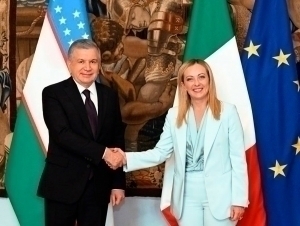
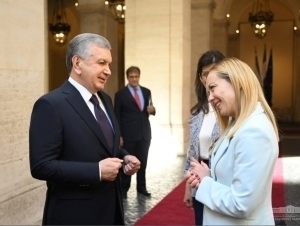
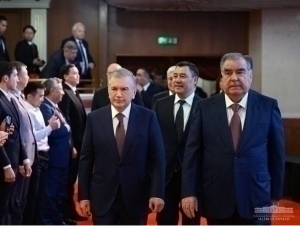
For reference, the summit was chaired by the President of Kazakhstan, Kassym-Jomart Tokayev, and attended by Italian Prime Minister Giorgia Meloni, President of Uzbekistan Shavkat Mirziyoyev, President of Kyrgyzstan Sadir Japarov, President of Tajikistan Emomali Rahmon, and President of Turkmenistan Serdar Berdimuhamedov.

Live
All