“Voracious” Trump
Review
−
06 January 13641 5 minutes
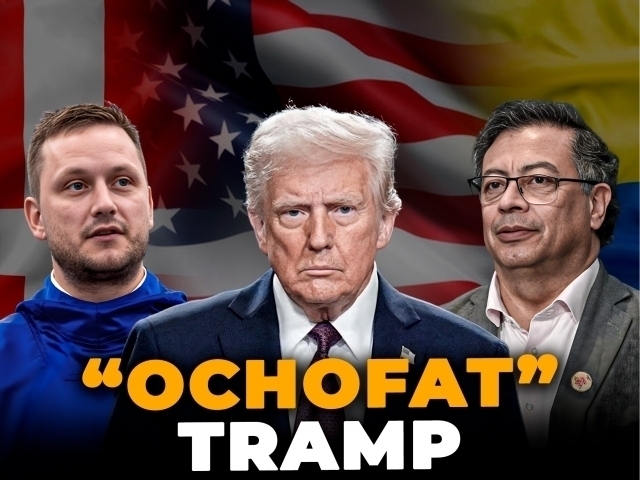
Even before the turmoil in Venezuela has had time to subside, the United States is openly signaling where its next claims may be directed. Since returning to office, U.S. President Donald Trump has appeared increasingly assertive, at times turning his attention to Latin American countries, at other times to Greenland, and occasionally even to Canada. Following Washington’s latest actions, a sense of unease has spread globally: if Venezuela was struck yesterday, it remains unclear whose fate may be decided tomorrow.
Is Bogota the next stop?
Whenever the White House justifies its actions by citing narco-terrorism, Venezuela is often mentioned alongside its neighboring country, Colombia, and the administration of its president, Gustavo Petro. Following the military operation in Venezuela on January 3, serious political tremors were felt in Bogota as well. Gustavo Petro, who has emerged as one of the initiators of calls to unite against the United States, has urged the international community to hold the Trump administration accountable. He was also among the first to voice sharp criticism over the alleged abduction of Nicolas Maduro.
Colombia, which has long been deeply entangled in the drug problem and was once notorious as the homeland of figures like Pablo Escobar, has yet to overcome this challenge. To this day, the country remains the world’s leading producer of cocaine, with more than 3,000 tons of narcotics reportedly produced annually. Modern indicators continue to set new records. Despite repeated government claims of successful operations against drug cartels, international statistics show little tangible improvement.
Gustavo Petro, who from the outset has responded sharply and without fear to Trump’s criticism, may well become the next target. On January 4, during a conversation with journalists aboard Air Force One, Trump accused Petro of involvement in drug production and did not rule out the possibility of an operation to remove him from power.
“Colombia is also in very serious condition. The country is being run by a sick man who likes producing cocaine and selling it to the United States, and he won’t be doing this for long,” Trump said.
The U.S. president also did not deny that a scenario similar to what unfolded with the Venezuelan leader could be repeated. While such statements may be dismissed as rhetoric, Colombia’s significant oil reserves suggest that these threats may not remain mere words. Trump has made little effort to conceal his intentions.
“This is good. It will bring prices down. It will benefit our country,” Trump added.
When asked whether his remarks implied the possibility of an operation against Colombia, Trump responded: “It doesn’t sound bad.”
In response, the Colombian leader reacted in his characteristic manner on the social media platform X.
“In Colombia, the judiciary does not report to me; it is independent and largely controlled by the opposition. If you want to know about the mafia and the cocaine trade, you only need to look at Colombia’s court archives. Therefore, I categorically reject Trump’s statements: over the past 50 years, neither in the past nor today has my name appeared in a single court case related to drug trafficking. Stop slandering me, Mr. Trump. You cannot speak in this tone to a Latin American president who emerged from armed struggle and later from the Colombian people’s fight for peace,” Petro wrote.
Whether Colombia could become the next target after Venezuela remains an open question. However, given Trump’s fondness for unexpected decisions, caution appears warranted.
“Sell Greenland”
Greenland is the largest island in the world. Although it formally belongs to the relatively small European state of Denmark, the massive territory has long attracted Trump’s interest. During his first term, he floated the idea of annexing the island, and it appears he has not abandoned that ambition. On January 4, once again speaking to journalists aboard Air Force One, Trump raised the prospect of purchasing or annexing Greenland.
“We need Greenland for national security reasons. It is a very strategic territory. Right now, there are Russian and Chinese ships all over the place. Greenland is a national security issue… Denmark cannot protect Greenland. Recently, they claimed to have strengthened security by adding just one more dog sled. It’s ridiculous,” Trump told reporters.
Such blunt remarks were poorly received by the Danish authorities. Greenland’s Prime Minister, Jens-Frederik Nielsen, strongly condemned the proposal, calling it “a fantasy.”
“There should be no more pressure. No more hints or insinuations. These fantasies about annexation must stop. We are ready for dialogue. We are ready for discussions. But this must be done through proper channels and with respect for international law,” the prime minister said.
He also emphasized that Denmark, including Greenland, is a NATO member and therefore under the alliance’s security guarantees. Under NATO’s charter, an attack on one member state would trigger a collective military response. This means that an attack by the United States, itself a NATO member, on another member would constitute a violation of the alliance’s principles. He further noted that a defense agreement granting the United States access rights to Greenland already exists.
In short, the 47th president of the United States, Donald Trump, appears eager to enter history as a conqueror. How Trump envisions the “Make America Great Again” (MAGA) movement remains a matter of debate, but its early signs look increasingly dangerous.

Live
All