“Vagrant” quotas and erased fines — stains on the image of the Interior Ministry
Review
−
09 April 7634 14 minutes
Strict demands were reportedly imposed on prevention inspectors to identify so-called vagrants. The target was specific — 300 cases. Failing to meet it was apparently not an option. District inspectors were allegedly expected to fulfill the quota even by listing themselves or their relatives as “vagrants” in order to close the plan.
On April 6 this year, audio and video circulated on social media in which an official from the Olmazor District Department for the Coordination of Internal Affairs Bodies in Tashkent was heard instructing prevention inspectors to find vagrants and draw up reports against them.
“Prevention inspectors, I am telling you again, and one more time: the number of vagrants is at zero. Are there no vagrants in Olmazor district? You keep letting them go after drawing up reports. Where are the vagrants now?” he says.
The audio also suggests that if no vagrants could be found, officers were expected to classify relatives as vagrants and prepare administrative reports.
“Everything is at zero. Every direction is at zero: vagrants zero, administrative reports zero, administrative supervision zero. What is wrong with you? Can none of you produce even one vagrant? Bring your relative and lock him up as a vagrant. You are the vagrant yourself,” he says.
This situation, which sparked heated public debate, raised many questions. If there is a “quota” of 300 vagrants in Olmazor district alone, have similar obligations been imposed on the other 11 districts of the capital? If so, and if each district is expected to produce 300 cases, does that mean there are 3,600 vagrants on the streets of Tashkent? More broadly, how lawful is it to issue an order with a fixed number for detaining homeless people? What exactly is meant by “detaining vagrants”? What type of individuals are being referred to? Does this include people who are not harming anyone and are not disturbing public order? Is the aim simply to meet a numerical target? Will this later be justified as crime prevention? Is it needed for statistics? Could this work to the detriment of certain citizens? There are many questions. But regardless of the explanation, the outcome is the same: a directive delivered in this tone and with this content inevitably makes the public’s attitude toward the system more doubtful and alarmed.
Today, we will discuss several of the stains that have fallen on the Interior Ministry because of the actions of some of its employees. Among them are the issue mentioned above, a senior official who allegedly used his position to have more than 100 fines issued to his spouse removed, a lieutenant colonel who allegedly tried to shield his brother after he assaulted a patrol officer, an operative who struck a citizen with his car and then allegedly disposed of the body in a canal to conceal the crime, and uniformed officers who allegedly tried to help criminals in exchange for money.
In the view of many people, criticizing is easy. In reality, the Interior Ministry is indeed a system that prevents numerous dangers the public may never know about. For various reasons, many of those cases are never made public, and those who show courage do not speak about their actions. Because of them, security is maintained, we go to sleep peacefully at night, and parents send even their young children to school without fear.
Because there is trust
There are many genuine officers in the system who remain loyal to their oath, place duty above any bribe, and defend justice even at the risk of their own lives. But this field is so sensitive that a thousand words of gratitude can be overshadowed by a single dark stain. One employee’s mistake can damage the reputation that thousands of honest colleagues have built over many years. We are compelled to speak today not to discredit the sector, but to preserve the true essence of that system and protect public trust in it. After all, justice must be equal for everyone.
One of the most widely discussed incidents of recent days — ridiculed by some, mocked by others, described by some as absurd, yet defended by others as justified — spread across social media on April 6.
The order to “catch vagrants,” which seemed strange to many, was given by an official from the Olmazor District Department for the Coordination of Internal Affairs Bodies in Tashkent. From his statement — “Everything is at zero. Every direction is at zero: vagrants zero, administrative reports zero, administrative supervision zero” — it can be understood that, in his view, certain indicators must never remain at zero. But is that not rather odd? Does this not suggest the existence of a plan?
However, the official response stated that no plan or numerical target had been imposed.
The Tashkent City Main Department of Internal Affairs issued a statement on the matter.
“In this area, the Tashkent City Main Department of Internal Affairs has not assigned any employee a requirement to fulfill a ‘plan.’ However, their duty is to identify persons violating public order. We ask media outlets to remain objective on this issue and not to look for faults in internal affairs officers who are simply carrying out their duties,” the statement said.
That was the official explanation. But now consider the words of Abror Khudoyberdiyev, who was giving the order. Then we can continue.
“Prevention inspectors, I have already given my word. I need to make it 300 by 12:00. If any one of you starts arguing now, do not be offended. Everyone must go out now, all of you. I will go out myself,” he says.
So why was there only one hour left? What was supposed to be reported at 10:00 p.m.? Why did he say the number of reports had to be raised to 500? To whom had this promise been given? Who is demanding numbers to such an extent that everyone must go out into the streets and draw up reports, with even the supervisor saying he will go himself? Unfortunately, there are no answers to these questions. An internal review has now been launched.
As noted above, incidents involving representatives of this sector, especially negative ones, quickly draw attention. Even when the misconduct is committed not by the officers themselves but by their close relatives, the first criticism often falls on the person in uniform. We saw proof of that quite recently.
Late at night on March 30 this year, on one of the streets in Tashkent’s Yashnobod district, a drunk driver was driving an unregistered Malibu, collided with another vehicle, and then argued with the other driver. The citizen then called 102 and filed a complaint. The traffic police and patrol officers who arrived at the scene reportedly faced serious resistance from the intoxicated offender, who even struck one of the officers while they were performing their official duties.
In fact, such confrontational situations do occur from time to time. But they are not usually discussed as widely as this one was. The reason, in this case, appears to be that the man who threw the punch was the brother of a lieutenant colonel, and that the senior officer himself was also present at the scene. The person filming the incident mentioned this several times during the video.
Judging from the video, the two brothers had apparently been traveling in the same car. In other words, there is a strong likelihood that the older brother knew his sibling was intoxicated. Yet he apparently did not stop him. It is also possible to conclude that after assaulting the officer, the drunk man repeatedly looked at his brother in the hope of support, while the man now referred to as the former lieutenant colonel can be seen condemning his brother’s actions.
The younger brother’s conduct also came at a cost to the elder brother. On April 3, the lieutenant colonel was dismissed. At a meeting held at the Sirdaryo Regional Department of Internal Affairs, the incident was described as a negative case indicating a possible abuse of official powers and the use of official standing for personal interests. Yes, using entrusted authority for personal gain cannot be justified in any way. But it is equally clear that reaching the rank of lieutenant colonel is not easy. Because of his brother’s actions while intoxicated, the older brother lost in a matter of minutes the status he had likely spent a large part of his life attaining. How many years might that path have taken?
Let us take a look
Under the regulations governing service in the Internal Affairs bodies of Uzbekistan, reaching the rank of lieutenant colonel requires not only time but also service in specific positions. This process is regulated by the “Regulation on the Procedure for Serving in the Internal Affairs Bodies.” On average, if an officer begins service with the rank of lieutenant, it takes at least 15 to 18 years to reach the rank of lieutenant colonel. If we break that down step by step, each promotion has a minimum service period: from lieutenant to senior lieutenant, two years; from senior lieutenant to captain, three years; from captain to major, four years; and from major to lieutenant colonel, five years. That means the period of serving in rank alone totals 14 years. But that is not all. To receive the rank of lieutenant colonel, an officer is usually expected to belong to the officer corps, which typically requires studying at the Academy of the Ministry of Internal Affairs. The three years of full-time education are also counted toward service. If an employee began in the enlisted ranks and only later became an officer, the total period may be even longer.
When speaking of Interior Ministry employees and their close relatives, many people will probably remember the scandal involving the deletion of 106 fines. On July 4, 2025, a Malibu-2 allegedly belonging to the wife of Fergana Regional Traffic Safety Department chief Lieutenant Colonel Akmal Baxtiyorovich Ahmedov was said to have committed 106 traffic violations. However, those violations were reportedly erased by decision of Captain Umaraliyev, head of the department’s administrative practice division.
After public complaints grew, with people saying that lawlessness and corruption were rising in Fergana, the regional Department of Internal Affairs’ Public Security Service conducted an internal investigation, and disciplinary measures were imposed on five employees of the Traffic Safety Department. Lieutenant Colonel Akmal Ahmedov, head of the regional Traffic Safety Department, was dismissed from his post. The fines imposed on the vehicle were recovered in full in favor of the state. Punishment was indeed imposed, but whether that erased the public impression that officials quietly settle their own matters behind closed doors remains doubtful. This is precisely why it must not be forgotten that the actions of a few individuals can shape public opinion about the entire system.
Another stain was left by a case that ended in death and an alleged attempt to conceal the crime. A senior operative of the Bekobod City Department of Internal Affairs reportedly drove while intoxicated and struck a 43-year-old pedestrian, who died as a result of the accident. The incident occurred on December 11, 2025, on the “Qorasuv-Bo‘ka-Bekobod” highway passing through the “Qoraqo‘yli” mahalla area of Bekobod district.
The officer allegedly tried to hide the traces of the crime by calling his wife and telling her to arrive at a designated location in a Matiz. He then reportedly transferred the body from his Nexia into the Matiz and disposed of it in the “Do‘stlik” canal, approximately 35 to 40 kilometers from the scene. From December 12, 2025, onward, special unit officers searched for the body. Nearly 80 days later, the remains were found 4 to 5 kilometers from the point where they had allegedly been thrown into the water.
That night, because of intoxication and speed, the life of a 43-year-old man was cut short. The person responsible was not an ordinary citizen, but a representative of the very sector that is supposed to fight crime and uphold justice. He, too, is human; perhaps he was frightened in those moments, perhaps he panicked, perhaps he was in shock. But the difference between an ordinary person and an officer in uniform lies in responsibility. The man who was supposed to find criminals became one himself. Instead of helping the victim, calling an ambulance, or admitting guilt, he allegedly chose a path that went against the oath he had taken — an attempt to conceal the evidence. As the hands meant to defend justice allegedly cast a body into a canal, not only one person but another piece of public trust in the system was swept away in those muddy waters.
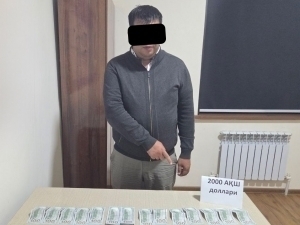
The next stains are linked to bribes allegedly taken in exchange for concealing crimes. Senior operatives from the Tashkent City Main Department of Internal Affairs’ Criminal Investigation Directorate and the Shayxontohur District Criminal Investigation Department allegedly tried to profit from a detected crime. In a case involving 3 grams of hashish allegedly found on a 1982-born resident of Olmazor district, they reportedly demanded $2,200 in exchange for not holding him criminally liable. They had allegedly already taken $1,000 from the suspect beforehand. One of the operatives was caught by officers of the Tashkent City Directorate of the State Security Service while receiving the remaining $1,200 not in the street or some hidden place, but in his official office — the very place allocated to him to uphold the rule of law.
Unfortunately, such cases are being uncovered all too frequently in various parts of the country. For example, in Tashkent region, an employee of the Ministry of Internal Affairs’ quarantine enforcement group was reportedly caught while receiving $500 in exchange for taking no action against a man trying to bring in meat unfit for consumption.
In Samarkand region, a prevention inspector of the Pastdarg‘om District Department of Internal Affairs was reportedly detained while taking $800 in exchange for not taking measures against a citizen in relation to documents under his review.
In Namangan region’s Davlatobod district, a patrol officer was reportedly caught while accepting gold jewelry worth 11 million soums as a bribe in exchange for not taking action after narcotics were found in a citizen’s vehicle.
In Xovos district of Sirdaryo region, two employees of the district Department of Internal Affairs allegedly demanded a bribe in exchange for burying a theft case. They had reportedly brought four citizens by force to the department building after suspecting them in the theft of polyethylene film from a field belonging to a horticultural company. To settle the case quietly, they allegedly demanded 55 million soums. One of those employees held the rank of lieutenant colonel, the other that of major. In all of these cases, those who stained the system were dismissed and subjected to legal measures.
Last year alone, hundreds of employees were removed from the system for exactly these kinds of actions — for failing to remain true to their oath. Although these figures may suggest that the system is being cleaned up, they also raise a painful question: who is taking the places of those who were removed? After all, wearing a state-issued uniform is not a privilege — it is a debt owed to the people’s trust.
When a person connected to the country’s internal affairs commits a crime, that individual stains not only his own name and that of his family, but also the honor of an entire state institution. As long as the concepts of “plan” and “quota” in the lower ranks are placed above human destiny, and as long as high-ranking officers treat their authority as a shield for the interests of their relatives, such stains will remain difficult to wash away. This is because citizens see the law — and how well it functions — through the figure of the Internal Affairs officer.

Live
All